
It has become easier than ever to create an online course thanks to technology, and it doesn’t take a lot of software or equipment to do so. Furthermore, you don’t need to break the bank to buy everything you need. Regardless of your budget, creating an online course that your students will appreciate is certainly doable with Thinkific. In this article, we will dig deeper and know what makes Thinkific the best course creation software as compared to other existing tools.
Let’s get started:
Table of Contents
What is Thinkific?
With approximately 50,000 instructors, Thinkific is a one-stop solution that would help you create online courses without getting into complex technicalities that you might have to face with other similar online course creation software.
Thanks to numerous easy-use Thinkific features, companies can create and market online courses. Using the course and site builder, live classes, affiliate partner management, and integration with solutions like Mailchimp, Shopify, and Zoom, entrepreneurs and small businesses can save time and money while building their online businesses.
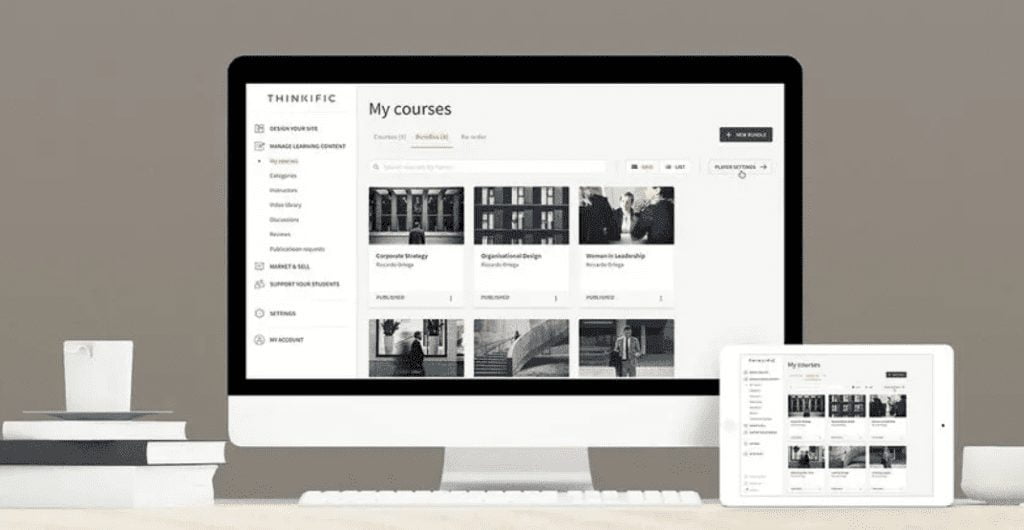
An overview of the Thinkific
Founded by Greg Smith in 2012, Thinkific is an online learning platform. Thinkific looks forward to revolutionizing the way people learn and earn online by turning their expertise into impactful businesses. Founded in Vancouver, British Columbia, in 1992, Thinkific now has over 100 employees.
Thinkific has developed a software platform that allows individuals and small-sized businesses to create, market, and deliver their online courses. In particular, Thinkific’s platform is well suited for the creation of live courses, and the use of learning reinforcement exercises such as exercises, surveys, and quizzes. In terms of technology, this is not as advanced as some of the other platforms on the market, but it does have the advantage of being powerful and convenient for both ambitious beginners and established course creators.
Among the more affordable options on the market, Thinkific’s most popular plan is $99. A majority of its plans are free, but others range from $499 to $999 per month.
Thinkific is an excellent mid-tier solution with a user-friendly interface, for those seeking a mid-tier solution. It is easy for beginning course creators to use the platform, and it also has the tools to support experienced course creators.
Thinkific Pricing & Cost
Thinkific Pricing ranges from free to $499 per month with Thinkific. You can also try Thinkific’s Pro plan for free during the trial period.
| Free | $0 per month Unlimited students |
| Basic | $49 per month $39 per month under annual subscription Unlimited students |
| Pro | $99 per month $79 per month under annual subscription Unlimited students |
| Premier | $499 per month $399 per month under annual subscription Unlimited students |
A Guide to Using the Basic, Pro, and Premier Thinkific Plans
There are many ways that can help you enhance your course even on Thinkific’s free plan. And there are multiple ways your small business can enhance its courses on Thinkific, using features and tips available on a regular-priced plan. Check the Thinkific site for specifics on what you can do with each plan.
| FREE | BASIC | PRO | PREMIER |
| Limited courses and unlimited students 1 site admin account Additional Features Included Easy drag and drop Course Builder Full e-commerce Easy to use website templates Email and phone support Thinkific App Store | 1 site admin account Additional Features Included Includes all Free features Live Chat support Custom domain Coupons & Promotions Drip (scheduled) content One-to-One Student Email Thinkific Academy Basic Courses | Unlimited courses, students, and content 2 site admin accounts Additional Features include Priority Support Private & hidden courses Subscription & Flexible Pricing Completion Certificates Single Communities Live lessons Advanced Course Building Thinkific Academy Pro Courses | Unlimited courses, students, and content 5 site admin accounts Additional Features include Includes all Free, Basic, and Pro features Groups Onboarding package 15 Group Analysts Unlimited Communities Brillium exams integration White labelling API access |
Consider the following Thinkific Features
The following sections will help you explore all the Thinkific features. Moreover, you will find screenshots of the product’s architecture and design.

Build a course
This amazing Course creation software can help you create and customize courses. You can create individual lessons within each chapter of your courses in Thinkific. Our overall assessment of Thinkific’s course builder was that it is intuitive, but somewhat limiting in terms of visual design.
When you upload multimedia to Thinkific, it can be video, audio, text, PDF, and presentations among other formats. Chapters can also include quizzes, assignments, and feedback.
Projects
You can create assignments within Thinkific for every chapter in your course. By using this feature, your students can submit homework to be completed before they can finish any chapter. You can give individual feedback on quiz performance to get an idea of how well your students are understanding your course material.
Students use Thinkific to upload their files for review by you as the instructor. Thinkific lets you:
- Prepare the assignment prompt
- Students can upload files that will help them complete their assignments
- Set a maximum file size of 100 MB
- Send confirmation messages when assignments are completed
Online quizzes
Additionally, Thinkific offers multiple-choice quizzes to reinforce your lessons. When you are an instructor, quizzes help you understand how well your students are learning. Quizzes also benefit your students because they provide feedback and suggest ways to improve.
There are a few features that can be customized in Thinkific quizzes, including
- Answering a question if it has more than one answer
- Answering a question by uploading a file, image, or video
- You should explain your question or answer
- Questions to import
- Passing a course grade unlocks subsequent lessons and material

Adaptability
It is important to design courses in a way that is accessible to students with a variety of learning styles and abilities. Thinkific offers some accessibility features including:
- Subtitling
- Transcriptions of videos in text
- Alt text
The following are additional features you can use to edit your courses
The Thinkific platform gives you the ability to brand your website and add courses in 39 different languages.
Your pages and courses can be branded without Thinkific branding with the Thinkific Pro and Growth plans. In addition, you can change the color scheme, add a logo, and add your favicon to your website.
Your website or course can be translated into 39 different languages through Thinkific, including:
- French
- German
- Hindi
- Japanese
- Korean
- Mandarin
- Spanish
Delivering the course
Creating your online course is only the first step. Delivering it to students in the next. There are several features in Thinkific that can assist you in scheduling the publication of your course content, teaching live classes, and supporting student interaction.
Creating a drip schedule
You can publish sections of your course at specific times using a drip schedule as an instructor. If you decide to use Thinkific, you can choose to deliver course content based on the following:
- Enrollment date for students
- Commencement date of students
- Specified date
In addition, Thinkific lets you choose how many days after a student enrolls or begins classes, course content will be released. The drip method can be selected only once per chapter in a course. This means that you cannot release one chapter based on a specific date and then release another chapter based on the student enrollment date.This means that you cannot release one chapter based on a specific date and then release another chapter based on the student enrollment date.

Attend a live class
An engaging learning environment is created by live classes. Thinkific integrates with Zoom to support live classes. The current beta version allows for 100 simultaneous participants. Because it does not require any coding, we found this feature to be user friendly.
Thinkific allows you to customize the following live class features:
- A live class could be a meeting or webinar
- Live classes are listed along with their dates, durations, and times
- Password for a meeting
- Record the class automatically if you choose
- Attendees should have a waiting area
Discussions between students
Within your lessons, Thinkific facilitates student discussion. Teachers and students can comment on each other’s posts. Engaging students in discussion is a great way to encourage a sense of community.
Instructors can also disable certain comments so that those comments do not appear to the rest of the participants in a discussion. These comments are not deleted, however. Additionally, comments cannot be edited after posting.
Feedback from students
Students can provide you with additional information about your classes through surveys. By using this information, your course material can consistently evolve which in turn will also increase student engagement.
Your courses can include surveys created by Thinkific as lessons. Survey questions in the platform can be one-word answers, multiple-word answers, ratings, scales, or free text.
Certifications
Upon successful completion of your courses, students can earn certificates. Students are motivated to achieve their goals by receiving certificates.
To use Thinkific’s certificate templates, you need to use one of their templates. Text can be edited, font colors can be changed, a logo can be uploaded, and the background color can be changed. You cannot sign your own certificates with Thinkific, as this is a minor drawback.
Advertising
Following the creation of your courses and course features, you need to determine the best method for marketing them. In addition to its website builder, Thinkific also offers coupons, bundles, affiliate marketing, and sales tracking tools which all integrate to form Thinkific’s USP.
Creating a site
Site building is made easy with Thinkific’s site builder, which lets you build your site and pages from scratch. When it comes to creating a site structure, Thinkific’s site builder is easy to use. Although the platform allows you to customize the design, we found that customization is limited.
You can customize the header, the sections, and the footer of each of your pages in Thinkific. You can make your header sticky so that the top navigation bar is visible while you scroll. In mobile, you can choose to display a menu label. Your footer can contain social media icons and links that connect your social media profiles to your website. The maximum number of social media profiles you can link to your website is three.
Your site and its elements can be customized by Thinkific. Furthermore, you can align elements either left, right, or center of the page. You can use Thinkific’s three themes as the basis for your website. There are three themes – Empire, Vogue, and Vision – each containing three to four styles.

Discounts
Promoting your courses through discount coupons increase sales. There are coupons available for one-time purchases, subscriptions, and payment plans on Thinkific. You can create coupons by choosing from the following options:
- You can give it a name
- Put an expiration date on it
- Specify a dollar amount or a percentage discount
- Choose the products to which the coupon can be applied
- Set the coupon code for the actual coupon
- Set the number of times a coupon can be used
Offers for course bundles
Your courses can be bundled together and offered at a discount with Thinkific. This will increase your average order value and customers will be enticed to purchase your courses.
Courses can be added to bundles as many times as you would like. It is also possible to create courses that are only offered as part of a bundle. As well, students who already purchased a bundle will automatically get access to additions to it in the future.
Tracking sales
The revenue you generate from your courses can be tracked by Thinkific. You can access a comprehensive sales report from Thinkific. In this tool, you can keep track of how your courses are performing and how affiliates and coupons are affecting your course sales.
When using Thinkific, you can access several pieces of key order information, including the name and email of the customer, the products they bought, the date they purchased the item, and the amount they spent on it.
Management of affiliates
Thinkific Affiliate marketing campaigns are the best and you should leverage it. Affiliates receive commissions in return for the sales they generate for your site. Affiliate programs are an excellent way to promote your courses to a broader audience.
In Thinkific, you can determine whether an affiliate receives fixed-dollar or percentage-based commissions. It is also possible to exclude certain courses from affiliate marketing. PayPal must be used for affiliate payments.
What are the specific Thinkific benefits which can help your business stand out?
Thinkific courses offer many benefits, including
- With Thinkific, you can quickly and easily create online courses
- It can be customized to match the brand of your business
- Course participants can be assessed by quizzes and knowledge checks
- Thinkific regularly launches new features and upgrades based on feedback from customers
- There is a free option as well as flexible pricing options. Getting started and experimenting with the platform is easy.
- Although Thinkific hosts your course, you can designate your own domain to access it. Your course will appear on your website.
- The online and phone support is excellent
- Your site is well protected with Thinkific. The host provides 24/7 secure hosting, regular automatic back-ups, and built-in SSL certificates
- Facebook and Google Adwords can be easily integrated with Thinkific data analytics
- Provides secure payment integration with PayPal and Stripe
- You can choose from a variety of course features. Sending content at predetermined times through a drip schedule. We also offer private, hidden, and multiple instructors courses, as well as membership sites
- Offers certificates of completion for those who have completed your Thinkific courses
- Each course page can be customized in Thinkific
- You can manage your students easily with an interface that is user-friendly.
How to use the free Thinkific pricing plan for small businesses?
It is possible to enhance the benefits your small business receives from Thinkific in several ways, as shown below. No matter what plan you choose!
1. Don’t overburden your learners
It’s common for new course designers in Thinkific to see a lesson type and think that when they have a different media type they need another type of lesson. The problem is that this will result in too many lessons being assigned, which overwhelms the learner.
To get the most out of your courses, you should map out the structure. Arrange the content accordingly.
2. Customize your text lessons
On the topic of text lessons, you can also customize Thinkific’s to fit your company’s branding. Text can even be styled in simple ways. For example, you can change the color of the text. Use colors that reflect your company’s brand to make your course stand out. Make your course visually appealing by including images or animated gifs. Follow good design principles to manage cognitive load. It won’t overwhelm learners.
As an example, the screenshot style on the right clearly shows the title (Winter) and subtitle for every month. Additionally, there is a decorative, free image.
An expert from Thinkific has created two video tutorials for Thinkific. You will learn how to utilize Thinkific features to enhance your course. There are several options in Thinkific to style your lesson text, one of which is Text Styling. Some accessibility factors are taken into account.
3. Add worksheets
Several tasks can be accomplished by incorporating worksheets into your course. Worksheets enhance the learning experience of your students. However, they need to be instructional sound.
According to an industry statement, “Telling ain’t training”. Video training isn’t really training. That’s what it is. When you make interactive videos, they become a powerful tool for training. In addition, worksheets can provide a way to go beyond passive content sharing.
The use of worksheets in your Thinkific courses gives your students the opportunity for authentic practice. Depending on your needs, the worksheet could be a fillable PDF, a Google Doc or a tool such as Course Notes. Considering your Thinkific course as a product, you would determine how to package it. What would you include? I would like to get a copy of the course only, or maybe some extra worksheets from the course, as well as some follow-up feedback. You can decide what price you want to charge for the course along with the expanded features and tools.

4. Incorporate examples into your Thinkific course
To help students learn what good looks like, examples are the best way. Here are a few suggestions:
- Add annotations or make your videos interactive. Make sure to do this if teaching a technique is the focus of your course
- You might consider creating examples of how someone should complete your worksheets if your course includes elements of inner reflection
- Case studies should be created. This is particularly helpful if your course focuses on a method or process. If you follow the process, you can provide insight into why it’s important. Some of these items could be re-purposed as freebies or loss leaders if you apply a product-based approach. You should also show how valuable your offerings are.
5. Adapt webinars to self-paced learning
Utilizing existing assets is one way to create a Thinkific course. You can take recorded webinars and deconstruct them. The audio, for example, is taken out and the transcription is made. This brings the new course into text format. Once the slides are redesigned, we use an authoring tool like Articulate Storyline. Once the audio and slides are synced, the course is converted into a self-paced Thinkific course.
In addition, we create new interaction opportunities through polls, Q&A sessions, and discussions. As an example, you could create multiple-choice questions from polls. It’s also possible to make a Q&A activity interactive by adding a click-to-reveal component. Likewise, you can use the transcription to create other supporting components for your course. Examples include e-books, workbooks, or extra content.
6. Utilize your existing assets
Several existing assets can be repurposed to develop your Thinkific course. Animated presentations, videos, podcasts, blog posts, brochures, infographics, and other forms of media can be useful. Plan how you will sequence your existing assets when reusing them. Remember to enhance the learning experience for your audience. To avoid creating a mishmash of disjointed slides. The course should be well-designed with an element of interaction.
7. Know What Your Course Is Worth To Your Audience
When you create a Thinkific course, it’s very important that you keep your target audience in mind as opposed to your expertise. A critical part of your course is to know what problem it will solve for your learners. You can approach this by considering the learner as an employer who is hiring your course for a particular job. This can be accomplished using the jobs-to-be-done framework. A ‘job to be done’ can be functional, social, or emotional.
Here are a few examples
We should pay attention to the emotional jobs. These are the jobs where value can be realized. It is the content you write that fulfils the “functional” job (I want to learn about ……). It is the social and emotional roles that contribute to job satisfaction. This requires product orientation. Doing market research will help you understand why your potential customers would purchase your course. Most of the time, it is not the content that makes them purchase it.
| Functional | Emotional | Social |
| Complete a task | Feel good | Look good |
| Solve a problem | Increase confidence | Gain status/power |
| Save time or money | Increase security | Perceived by others |
8. Perform keyword research to check the validity of your course idea
Do you think your course idea is good? What if you were able to test your idea first to see how popular it will be? Fortunately, you can. It is possible to determine how popular your topic will be by doing some inexpensive keyword research. Moreover, you will have to consider how much competition there will be from other courses aiming at the same audience. To help our clients, we provide a report that shows how often students search for specific key terms related to a particular course topic. This is how many people are interested in your topic, or how likely they are to take a course about it. In addition, we can identify how competitive your topic is. Furthermore, we identify important nuances that may help you to focus, position, or market your course. In the case of creating a course on a popular topic, how can you best get a piece of the pie? Would it be possible to create your own course to fill a void in an under-served market.
9. Improve Your Video Lessons’ Instruction
A passive viewer may not realize what they need to pay attention to when watching your videos. Therefore, add text under the video lesson to guide them. This also provides the learner with more variety within the course.
As well as downloading tools that can help your learner put what they’ve learned into practice. Downloadable worksheets are an excellent idea under the video. You can then give them the opportunity to practice what you have taught them.
You should give the learner some tools so they can do something different. You can include checklists, reference guides, illustrations, completed examples, or screenshots that are helpful. Videos can be created using several tools. The video sharing service Motionbox, for instance, has a lot of cool and impressive features.
10. Animate some of your videos
Videos using talking head instructors can be helpful sometimes. However, talking doesn’t count as training, as the old adage says. Therefore, substitute other activities for talking head videos.
Instead of watching talking head videos, substitute other activities. It is better to either add visuals that reinforce what you intend to convey or at least enhance them. You might add pictures, illustrations, schematics, or charts to support what you wish to convey.
Don’t overload your brain with too much information. Don’t entertain your audience with too much information. Rather than helping them retain knowledge in the short term, you are helping them convert that knowledge to the long term. In addition to Castofly, Vyond, and Adobe After Effects, you can try a variety of other tools as well. By using these tools, your Thinkific videos will be more engaging.
11. Online instructional videos
The use of video in education has been proven to be very effective. In your Thinkific course, video can enhance learning.
You may not have made a video before, so making one can seem intimidating. You can, however, find a lot of excellent resources online. An excellent guide to making instructional videos can be found at Techsmith. The article explains what instructional videos are and the common mistakes people make when watching them. Additionally, we will teach you how to create an instructional video with a camera and how to record a screencast.
In this article, cognitive load and cognitive theory are explained. Detailed recommendations are given to create an effective instructional video. These include:
- Video length should be limited to 30 seconds and focus on learning objectives
- Make your explanation as clear and compelling as possible by combining audio and video elements.
- How to create an environment that is conducive to active learning
12. Utilize high-quality images
Getting quality images for your course can sometimes be a challenge. You can enhance your Thinkific course by including relevant quality images. There are many free sites online where you can obtain high-quality pictures nowadays. Consider using Unsplash, Pexels, or Pixabay.
In any case, adding images is not just decorative. Take the following steps:
- Your images should convey the message you want to convey
- Give credit to the owner
- Make alt-text available (important for accessibility AND search engine optimization)
- Make sure your brand is reinforced with appropriate style elements. For instance, a color wash, and text overlays.
13. Using Thinkific for audio lessons
An online course might not seem like the best fit for audio lessons. Nonetheless, if your content doesn’t require visual instruction, an audio lesson may be worth exploring. This is a great method for someone who is commuting or walking while listening to a lesson. Thinkific offers audio lessons, or you can use integrations like Hello Audio on the basic plan. Pod courses can also be created. If you need to repurpose the audio content in another way, ensure that you transpose the audio. In addition to e-books and supplemental texts, you can also create social media posts.
14. Take advantage of semi-synchronized options
The majority of COVID-19 participants utilized virtual meeting platforms like Zoom to deliver their training. Using one of these options as your only option can have its limitations, however. It is possible, though, to encounter limitations if you choose just one of these options. As an example, running lots of live classes (where you teach online) can be exhausting.
In addition to synchronous options, Thinkific allows for some semi-synchronous options. This not only gives your course more variety, but also gives you as an instructor a break from the workload. The tool e–Webinar is a good example.
With the Basic Thinkific plan, you can use e-Webinars. Your webinar can be recorded and included in your Thinkific course after it has been recorded. In this case, you could start with a pre-recorded webinar instead of all your lessons being live. Once that’s over, you could progress to live interaction. You could then have a discussion in groups.
In addition, the Zoom integration within Pro Thinkific allows you to use a flipped-classroom approach. Here, you’d complete your Thinkific lesson while trying to apply the theory.
There will be a second lesson which will be a live Zoom link afterwards for applying the theory. Participants can present what they learned, break into small groups to discuss, or go through a case study.
15. Take advantage of drip options
One nice aspect of Thinkific is that you can use email programs to drip feed your content to your audience. By doing so, you can add to your course. Repetition and retention of a subject will increase as a result. For instance, you can:
- Provide a link to the new content
- Inform readers of topical “news” by sending a link to a webpage, an episode of a podcast or a video
- Send a link to a community discussion
- Book events one-on-one or with small groups, and share the booking site
- Provide a link to an additional download
Alternatively, you can set up your course in a series of ‘drip’ lessons if you do not want to use email notifications. A recurring schedule, based on a specific date (e.g. weekly), is used. Items are completed upon completion. The free version provides some of these features.
What payment method is accepted by Thinkific?
Payments are not processed through Thinkific’s platform. A 3% transaction fee will apply to transactions through PayPal and Stripe, however. You can charge for Thinkific courses using a one-time payment, a subscription, a membership, or a monthly payment plan. Free courses are also available.
A legal and security perspective
Login credentials and payment credentials are necessary to use course creation software. Your software must meet certain legal and security standards in order to protect sensitive information.
How’s the customer service of Thinkific?
In order to guarantee a satisfactory customer experience, providing efficient customer support is essential. The customer service provided by Thinkific is slightly above average. A major disadvantage of their customer support is that they do not offer a live chat service that allows you to speak with a representative.
Thinkific’s help articles are filled with useful information. This book not only contains text but also images and videos that help the reader visualize what steps they should take. Also bolded are key terms, such as Thinkific terms, so they can easily be recognized.
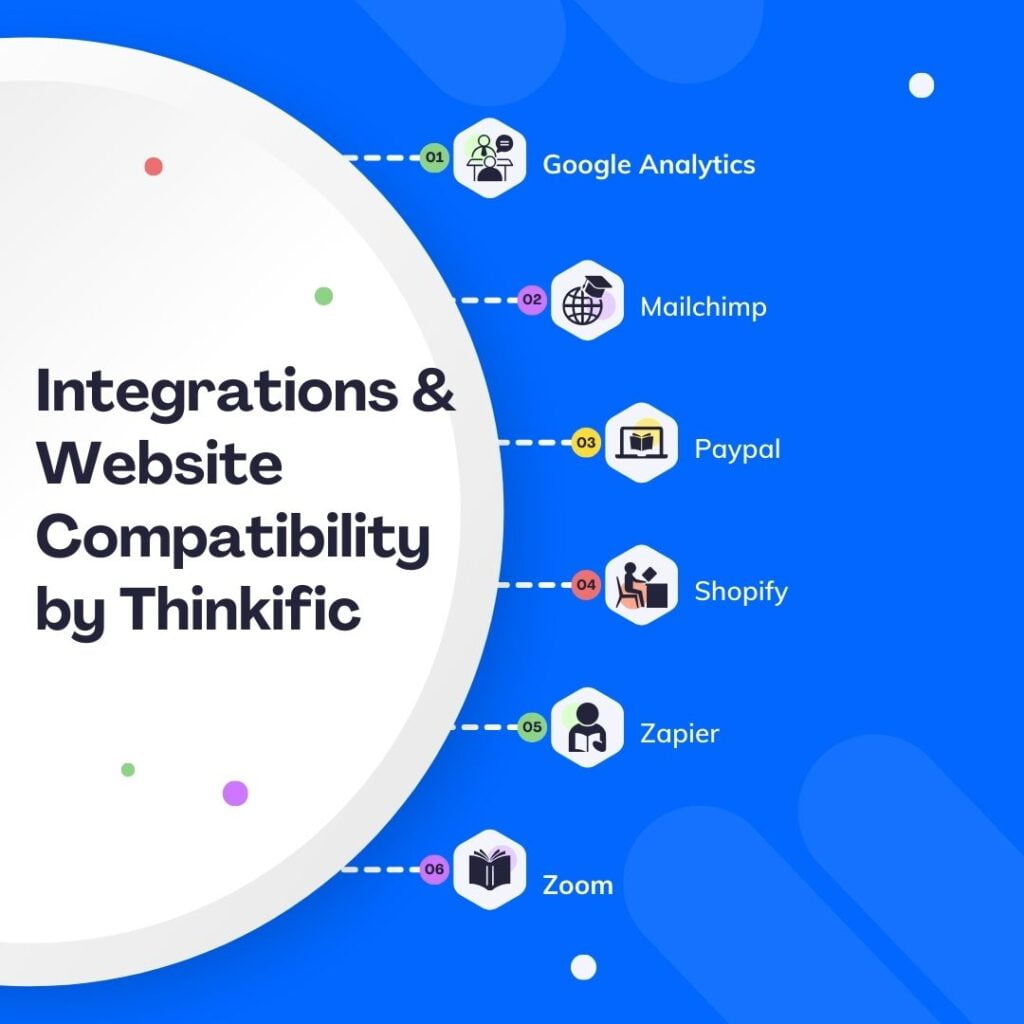
Integrations & Website Compatibility by Thinkific
You can maximize your course and site efforts with Thinkific’s key integrations and website compatibilities. Integrations can be found to help you create, market, sell and deliver your online courses. Among them are:
There are numerous website builders that are compatible with Thinkific. These include:
- WordPress
- Weebly
- WIX
- Squarespace

Thinkific: Is it the right fit for you?
Thinkific offers online course creation and marketing tools to more than 50,000 instructors. Although it is not the most advanced platform on the market, it is easy to use and very powerful.
Our review of Thinkific concluded that it is the perfect solution for anyone who needs a user-friendly, mid-tier solution. Despite its ease of use, the platform also has the tools to support experienced creators.

Shiraz Qamar is a seasoned expert in software and technology content, with years of hands-on experience in reviewing software and leveraging it to drive business success. His deep understanding of tech trends, user needs, and business applications enables him to deliver insightful reviews and practical advice. Whether evaluating the latest tools or optimizing solutions for real-world challenges, Shiraz's expertise bridges the gap between innovation and usability, empowering businesses to thrive in a tech-driven world.