
Ever wondered whether Systeme.io or Mailchimp is the right tool for your business? Both platforms cater to online entrepreneurs, offering marketing automation and email marketing solutions. However, they serve different types of users—one being an all-in-one business platform, while the other specializes in email marketing. Having explored both platforms extensively, I can break down their differences to help you determine which aligns with your goals.
Disclaimer: This article is based on publicly available information. Please verify pricing and features on the official websites, as updates may occur.
Table of Contents
Systeme.io vs Mailchimp: Quick & Simple Comparison
| Feature | Systeme.io | Mailchimp |
| Ease of Use | Beginner-friendly with intuitive design | User-friendly but can be complex for advanced features |
| Onboarding | Tutorials and step-by-step guides available | Straightforward setup with ample resources |
| Sales Funnels | Advanced funnel-building tools | Lacks native funnel-building capabilities |
| Marketing Automation | Multi-channel automation (email, sales funnels, memberships) | Primarily focused on email automation |
| CRM & Lead Management | Integrated CRM with contact management and segmentation | Basic audience management with tagging |
| Membership & Courses | Fully integrated with sales funnels | Requires third-party integrations |
| Webinars | Built-in webinar hosting | No native webinar support |
| Landing Pages | Drag-and-drop page builder with customizable templates | Basic landing pages with limited customization |
| Integrations | Moderate third-party integrations | Extensive third-party integrations |
| Customer Support | 24/7 chat and email support | Email support and community forum |
| Pricing | Starts at $27/month | Free plan available; paid plans start at $13/month |
| Free Trial | Free plan available | Free plan available |
| Best For | Entrepreneurs, course creators, businesses needing comprehensive tools | Bloggers, small businesses, and email marketers |
What is Systeme.io?

Systeme.io is a robust marketing platform that provides an all-in-one solution for running an online business. Whether you need sales funnels, email automation, course hosting, or lead management, Systeme.io handles everything in a single system. It was created by Aurélien Amacker and officially launched in 2018. Since then, it has become a preferred choice for digital entrepreneurs who want a seamless business management system.
Who Should Use Systeme.io?
Systeme.io is designed for:
- Entrepreneurs managing online sales and marketing
- Course creators and coaches selling memberships
- Small businesses looking for a complete marketing solution
- Agencies managing multiple clients (with higher-tier plans)
If you want a centralized platform to manage marketing, sales, and automation, Systeme.io is a solid option.
What is Mailchimp?
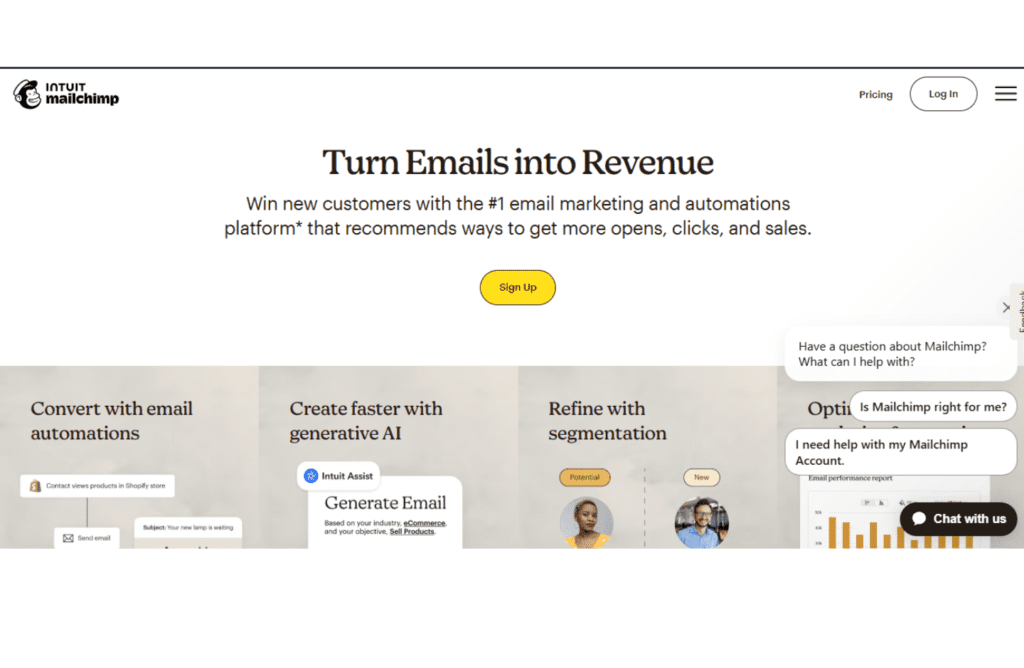
Mailchimp is an email marketing tool primarily designed for businesses and content creators. It allows users to build email lists, create automation sequences, and engage their audience through email-driven campaigns. While it excels in email marketing, Mailchimp does not offer advanced CRM, funnel-building, or business management features like Systeme.io.
Who Should Use Mailchimp?
Mailchimp is perfect for:
- Bloggers and content creators who rely on email marketing
- Small businesses focused on audience engagement
- Digital marketers who prefer simple automation over complex funnels
- E-commerce businesses looking to integrate email marketing
If your primary focus is email marketing rather than full-fledged business automation, Mailchimp is a great option.
Systeme.io vs Mailchimp – Key Similarities and Differences
While Systeme.io and Mailchimp both offer marketing automation, they differ in their approach. Let’s examine their similarities and differences.
Similarities
- Both offer automation features to nurture leads and build relationships.
- Each provides email marketing tools, including segmentation and autoresponders.
- Both integrate with third-party tools to expand functionality.
- Each platform has a free plan to test its features before committing.
Differences
| Feature | Systeme.io | Mailchimp |
| Ideal For | Businesses needing full marketing automation | Content creators focused on email marketing |
| Sales Funnels | Advanced funnel mapping tools | Lacks native funnel-building capabilities |
| CRM & Lead Management | Full contact tracking and sales automation | Basic audience management with tagging |
| Membership & Courses | Built-in course hosting and member areas | Requires third-party integrations |
| Webinar & Video Hosting | Includes built-in webinars and video hosting | No native webinar features |
| Landing Pages | Fully customizable templates | Basic landing pages with limited customization |
| Customer Support | Live chat, email, and ticket support | Email-only support |
Pricing and Plans
When choosing between Systeme.io and Mailchimp, understanding their pricing structures is crucial to determine which platform aligns best with your business needs. Let’s dive into the details of each.
Systeme.io Pricing
Systeme.io offers four distinct pricing plans, each designed to cater to different stages of business growth:
- Free Plan: Ideal for beginners, this plan allows management of up to 2,000 contacts and includes features like unlimited emails, sales funnels, blogs, and courses. It’s a comprehensive starter pack without any cost.
- Startup Plan ($27/month): Suitable for growing businesses, this plan supports up to 5,000 contacts and offers additional features such as 10 sales funnels, 5 membership sites, and advanced automation rules.
- Webinar Plan ($47/month): Designed for businesses focusing on webinars and online courses, it accommodates up to 10,000 contacts and includes 50 sales funnels, 20 membership sites, and webinar hosting capabilities.
- Unlimited Plan ($97/month): For established businesses, this plan offers unlimited contacts, sales funnels, membership sites, and advanced features like evergreen webinars and priority support.
Mailchimp Pricing
Mailchimp provides four pricing tiers to cater to various business sizes and needs:
- Free Plan: Perfect for startups, this plan allows management of up to 500 contacts and includes basic email templates, landing pages, and single-step automation.
- Essentials Plan (Starting at $13/month): For growing businesses, this plan supports up to 50,000 contacts (pricing increases with contact count) and offers all Free Plan features plus access to all Mailchimp templates, A/B testing, and 24/7 email and chat support.
- Standard Plan (Starting at $20/month): Aimed at businesses seeking advanced automation, this plan includes all Essentials features, supports up to 100,000 contacts, and adds advanced audience insights, retargeting ads, and custom templates.
- Premium Plan (Starting at $350/month): Designed for large enterprises, this plan offers advanced segmentation, multivariate testing, unlimited contacts, and priority support.
Comparison Table: Pricing
| Feature | Systeme.io | Mailchimp |
| Free Plan | Up to 2,000 contacts with unlimited emails | Up to 500 contacts with 2,500 emails/month |
| Entry-Level Paid Plan | $27/month for 5,000 contacts | $13/month for 500 contacts |
| Mid-Tier Plan | $47/month for 10,000 contacts | $20/month for 500 contacts |
| Top-Tier Plan | $97/month for unlimited contacts | $350/month for 10,000 contacts |
| Additional Costs | None | Costs increase with additional contacts |
🌟 Winner: Systeme.io
Systeme.io offers more cost-effective plans, especially for businesses with larger contact lists, providing comprehensive features without escalating costs.
User Experience & Ease of Use
Your marketing platform should be easy to navigate, whether you’re a beginner or an experienced marketer. A simple and intuitive interface can save time and enhance productivity.
Systeme.io
Systeme.io is designed as an all-in-one marketing platform, making it accessible even for beginners. The user interface is clean and straightforward, with a drag-and-drop editor that simplifies creating sales funnels, landing pages, email campaigns, and automation workflows.
- Dashboard: The dashboard is intuitive, showing an overview of key business metrics, including sales, automation, and subscriber growth. Users can quickly access different tools without excessive navigation.
- Ease of Setup: Systeme.io provides a smooth onboarding process with step-by-step guides and video tutorials to help new users get started. Setting up a funnel or email campaign takes only a few clicks.
- Automation & Navigation: Since all tools are integrated into one platform, users don’t have to switch between different apps, reducing the hassle of managing multiple tools.
However, because Systeme.io includes a wide range of features (funnels, email marketing, courses, and membership sites), some users may experience a slight learning curve when using advanced automation features.
Mailchimp
Mailchimp primarily focuses on email marketing, and its platform reflects that specialization. The user interface is visually appealing and user-friendly, making it a good option for beginners.
- Dashboard: The dashboard provides an overview of email performance, subscriber growth, and recent campaigns. The layout is simple and well-organized, ensuring users can quickly find the tools they need.
- Ease of Setup: Mailchimp provides pre-designed email templates and automation workflows, making it easy to set up email campaigns without needing design skills.
- Automation & Navigation: While Mailchimp has solid automation for email campaigns, navigating between different features—especially when dealing with audience segmentation—can sometimes feel unintuitive. Users often need to dig through menus to locate specific functions.
Mailchimp is easy to use for simple email campaigns, but users who want to build advanced automation sequences or integrate multiple marketing tools may find its workflow less streamlined.
Comparison Table: User Experience & Ease of Use
| Feature | Systeme.io | Mailchimp |
| Ease of Use | More user-friendly and simple to navigate ✅ | Easy for basic email campaigns but can feel complex when managing automation ❌ |
| Dashboard Design | Minimalist and efficient ✅ | Visually appealing and well-organized ✅ |
| Learning Curve | Slight learning curve due to advanced features ❌ | Lower learning curve for beginners ✅ |
| Onboarding Support | Step-by-step tutorials and guides ✅ | Help articles and video tutorials ✅ |
🌟 Winner: Systeme.io
Both platforms offer a user-friendly experience, but Systeme.io wins because of its all-in-one approach and seamless navigation between different tools. While Mailchimp is easier for simple email marketing, users who need more than just email campaigns may find Systeme.io’s interface more efficient.
Email Marketing & Automation
Email marketing is a crucial aspect of any digital marketing strategy. The ability to automate campaigns, segment audiences, and track performance makes a huge difference in growing an online business.
Systeme.io
Systeme.io includes built-in email marketing with automation features. Users can create:
- Email Sequences: Automate emails based on user actions, such as signing up for a freebie or purchasing a product.
- Tagging & Segmentation: Tag subscribers based on their behavior, allowing for personalized email campaigns.
- Transactional Emails: Send order confirmations, receipts, and other business-related emails.
- Deliverability: Systeme.io ensures high email deliverability rates by managing email servers and keeping spam rates low.
Systeme.io’s automation tools allow users to create sales funnels that integrate with their email campaigns seamlessly. For example, users can build a funnel that collects leads, delivers a free eBook, and then nurtures them with automated emails—all from one platform.
Mailchimp
Mailchimp is known for its strong email marketing features, including:
- Pre-built Email Templates: Professionally designed templates for different industries and occasions.
- A/B Testing: Test different email subject lines, content, and send times to optimize open rates.
- Segmentation & Personalization: Create detailed audience segments based on demographics, purchase history, and engagement.
- Automation Workflows: Set up automated email sequences, such as welcome emails, abandoned cart reminders, and follow-ups.
While Mailchimp has powerful email marketing tools, its automation capabilities are more limited compared to Systeme.io, especially when integrating with sales funnels. Users looking for a complete automation system beyond email marketing may find Mailchimp less versatile.
Comparison Table: Email Marketing & Automation
| Feature | Systeme.io | Mailchimp |
| Email Sequences | Advanced automation based on triggers ✅ | Strong automation for email campaigns ✅ |
| Segmentation & Tagging | Built-in tagging and segmentation ✅ | Detailed audience segmentation ✅ |
| A/B Testing | Not available ❌ | Available in paid plans ✅ |
| Deliverability | High deliverability rates ✅ | Reliable but depends on the plan and sending reputation ✅ |
| Integration with Funnels | Fully integrated with sales funnels ✅ | Requires third-party tools ❌ |
🌟 Winner: Systeme.io
While Mailchimp has strong email marketing tools, Systeme.io wins because of its seamless integration with funnels and automation. If you’re looking for an all-in-one platform that connects email marketing with sales processes, Systeme.io is the better choice.
Sales Funnels & Landing Pages
Sales funnels and landing pages are essential for capturing leads and converting visitors into customers.
Systeme.io
Systeme.io includes a built-in funnel builder, allowing users to create high-converting pages for lead generation, product sales, and webinar registrations. Features include:
- Drag-and-Drop Builder: Easily create and customize landing pages with a simple editor.
- Pre-designed Funnel Templates: Choose from various funnel templates for different purposes (lead magnets, product launches, etc.).
- A/B Testing: Compare different versions of landing pages to optimize conversions.
- Integrated Checkout Pages: Sell products and services directly from your funnel without needing third-party payment processors.
Mailchimp
Mailchimp provides a basic landing page builder, but it’s not as advanced as Systeme.io. It offers:
- Pre-made Templates: Customize pages using ready-made templates.
- Lead Capture Forms: Collect emails and grow subscriber lists.
- Basic Customization: Limited options for modifying page elements compared to Systeme.io.
Mailchimp’s landing pages are sufficient for basic lead generation but lack the depth and flexibility of Systeme.io’s sales funnel builder.
Comparison Table: Sales Funnels & Landing Pages
| Feature | Systeme.io | Mailchimp |
| Sales Funnel Builder | Fully integrated sales funnels ✅ | No funnel builder ❌ |
| Landing Page Templates | High-converting templates ✅ | Basic landing pages ❌ |
| Drag-and-Drop Editor | Yes ✅ | Yes ✅ |
| A/B Testing | Available ✅ | Limited ❌ |
| Checkout Integration | Built-in checkout pages ✅ | Requires third-party tools ❌ |
🌟 Winner: Systeme.io
If you need sales funnels, Systeme.io is the clear winner. Mailchimp is suitable for basic landing pages, but it doesn’t provide full sales funnel functionality.
Integrations & Third-Party Compatibility
Integrations are essential for connecting your marketing platform with other tools such as payment gateways, CRMs, and webinar platforms.
Systeme.io
Systeme.io offers a solid range of built-in tools, reducing the need for third-party integrations. However, it still provides compatibility with essential external services:
- Payment Gateways: Supports Stripe and PayPal for processing payments directly within sales funnels.
- Zapier Integration: Connects with thousands of third-party apps for extended functionality.
- Webinar & Course Platforms: Comes with a built-in course and webinar system, so external tools aren’t necessary.
- Email & CRM: Includes its own email marketing system, reducing reliance on external email marketing tools.
Because Systeme.io is an all-in-one solution, it eliminates the need for excessive integrations. However, if you rely on specific third-party apps beyond its core offerings, you might need Zapier to connect them.
Mailchimp
Mailchimp is highly dependent on integrations because it primarily focuses on email marketing. It integrates with:
- E-commerce Platforms: Shopify, WooCommerce, BigCommerce, and Magento.
- CRM & Customer Support Tools: HubSpot, Salesforce, and Zendesk.
- Social Media & Ads: Facebook, Instagram, and Google Ads for automated campaigns.
- Payment Processors: Stripe and PayPal (only for e-commerce tracking).
While Mailchimp offers more native integrations than Systeme.io, many require a paid plan to access, and it still lacks an all-in-one system for courses, webinars, and sales funnels.
Comparison Table: Integrations & Third-Party Compatibility
| Feature | Systeme.io | Mailchimp |
| Built-in Payment Processing | Stripe & PayPal ✅ | Only for e-commerce tracking ❌ |
| Zapier Integration | Available ✅ | Available ✅ |
| E-commerce Compatibility | Built-in store functionality ✅ | Shopify, WooCommerce, BigCommerce ✅ |
| Webinar Support | Built-in webinar tools ✅ | Requires third-party integration ❌ |
| CRM & Lead Management | Built-in CRM ✅ | Requires external CRM integration ❌ |
🌟 Winner: Systeme.io
Mailchimp offers more native integrations, but Systeme.io provides an all-in-one experience with built-in tools for funnels, courses, and webinars. If you need a complete system without relying on multiple integrations, Systeme.io is the better option.
Customer Support & Community
Reliable customer support ensures that users can get help when facing technical issues.
Systeme.io
Systeme.io offers:
- Email Support: Available for all plans, including the free plan.
- Live Chat: Available for paid users, providing quicker assistance.
- Knowledge Base: Detailed guides and tutorials to help users navigate the platform.
- Community: A private Facebook group where users can ask questions and share strategies.
The response time for email support is generally fast, and the community is active, making it easier for users to troubleshoot common problems.
Mailchimp
Mailchimp provides:
- Email Support: Available only for paid users. Free users don’t get direct support.
- Live Chat: Available in the Essentials plan and above.
- Phone Support: Only available in the Premium plan ($350/month).
- Help Center & Knowledge Base: Offers articles and guides, but the lack of direct support for free users can be a drawback.
While Mailchimp provides multiple support channels, free users don’t get customer support, and phone support is limited to the most expensive plan.
Comparison Table: Customer Support
| Feature | Systeme.io | Mailchimp |
| Email Support | Available for all users ✅ | Only for paid plans ❌ |
| Live Chat Support | Available for paid plans ✅ | Available for paid plans ✅ |
| Phone Support | Not available ❌ | Only in Premium plan ($350/month) ❌ |
| Community & Facebook Group | Active Facebook community ✅ | No official community ❌ |
| Knowledge Base | Detailed guides & tutorials ✅ | Extensive help center ✅ |
🌟 Winner: Systeme.io
Systeme.io offers better customer support for all users, including free plans, while Mailchimp restricts support to paid users and only offers phone support at a premium price.
Pros and Cons of Systeme.io
Pros
✅ Beginner-Friendly & Easy to Use
Systeme.io offers an intuitive interface with a drag-and-drop builder, making it simple for beginners to create landing pages, sales funnels, and email campaigns. You don’t need technical skills to get started, and the platform provides step-by-step tutorials to guide users through the setup process.
✅ Affordable Pricing with a Free Plan
One of Systeme.io’s strongest advantages is its cost-effectiveness. Unlike Mailchimp, which restricts advanced features to higher-tier plans, Systeme.io provides essential marketing tools—including sales funnels, email automation, and affiliate management—even in its free plan. This makes it an excellent choice for solopreneurs and startups with tight budgets.
✅ All-in-One Marketing Solution
With built-in tools for email marketing, course hosting, membership sites, sales funnels, and automation, Systeme.io eliminates the need for multiple third-party tools. This allows users to manage their entire online business from one platform, reducing costs and complexity.
✅ Built-In Affiliate Program Management
Unlike Mailchimp, which does not offer native affiliate marketing features, Systeme.io includes affiliate program management. Users can create their own affiliate system, set commission rates, and track affiliate performance—all within the platform.
✅ Fast and Simple Sales Funnel Creation
Systeme.io provides ready-to-use funnel templates, allowing users to quickly set up high-converting sales funnels. The platform’s seamless integration between landing pages, checkout pages, and email sequences makes the sales process smoother and more effective.
✅ Unlimited Emails on All Plans
Unlike Mailchimp, which limits email sends based on pricing tiers, Systeme.io allows users to send unlimited emails, even on lower-tier plans. This is a huge advantage for businesses that rely heavily on email marketing.
✅ No Additional Transaction Fees
Some marketing platforms charge extra transaction fees on top of standard payment processing fees, but Systeme.io does not. Whether you sell courses, memberships, or digital products, you keep more of your revenue.
Cons
❌ Limited Advanced Customization
While Systeme.io is beginner-friendly, its customization options are more limited compared to Mailchimp. If you need highly customized email templates or complex branding elements, you might find Mailchimp’s email editor more flexible.
❌ Basic Reporting & Analytics
Systeme.io provides fundamental analytics for tracking sales and email performance, but its reporting features are not as advanced as Mailchimp’s. Mailchimp offers A/B testing, detailed engagement reports, and predictive analytics, which can be useful for businesses that rely on data-driven marketing.
❌ Limited Third-Party Integrations
While Systeme.io has built-in tools for most marketing needs, it doesn’t offer as many direct integrations as Mailchimp. Users relying on CRM systems, advanced automation tools, or specialized e-commerce platforms may need to use Zapier to connect Systeme.io with other apps.
❌ No Dedicated Mobile App
Unlike Mailchimp, which provides a mobile app for managing campaigns on the go, Systeme.io does not have a dedicated app. This can be a drawback for users who prefer to monitor their marketing activities from their smartphones.
Pros and Cons of Mailchimp
Pros
✅ Powerful Email Marketing Tools
Mailchimp is one of the most advanced email marketing platforms, offering features like A/B testing, dynamic content, email segmentation, and predictive analytics. If your primary focus is email marketing, Mailchimp provides greater depth in this area than Systeme.io.
✅ Highly Customizable Email Templates
Mailchimp’s drag-and-drop email builder allows for extensive customization, making it easy to create professional and visually appealing emails. Unlike Systeme.io, which has basic email customization, Mailchimp provides more flexibility with branding and design.
✅ Strong Third-Party Integrations
Mailchimp integrates seamlessly with Shopify, WooCommerce, BigCommerce, Salesforce, HubSpot, and hundreds of other tools. This makes it an excellent option for businesses that need a marketing tool that works well with their existing software stack.
✅ AI-Powered Recommendations & Analytics
Mailchimp offers AI-powered insights, helping users optimize their campaigns by predicting the best times to send emails, recommending subject lines, and providing in-depth engagement analytics. Systeme.io’s analytics tools are much more basic in comparison.
✅ Mobile App for On-the-Go Management
With the Mailchimp mobile app, users can monitor campaigns, track engagement metrics, and make edits directly from their phone. Systeme.io does not have a mobile app, making Mailchimp more convenient for marketers who need access while traveling.
✅ Free Plan for Small Email Lists
Mailchimp provides a free plan for users with up to 500 contacts, which includes basic email automation and analytics. However, this free plan is more limited than Systeme.io’s, as it restricts advanced automation and lacks key features like sales funnels and affiliate management.
Cons
❌ Higher Costs as Your List Grows
Mailchimp’s pricing is based on the number of contacts, and it can get expensive quickly. Once you exceed 500 subscribers, you must upgrade to a paid plan, and pricing increases significantly as your list grows. In contrast, Systeme.io provides unlimited email sending on all plans, making it a more cost-effective choice for businesses scaling their marketing efforts.
❌ No Sales Funnel Builder
Mailchimp is not designed for sales funnels—it focuses primarily on email marketing. If you need landing pages, checkout pages, and upsell features, you’ll need additional tools or integrations, whereas Systeme.io has these built-in.
❌ No Built-In Affiliate Program Management
Unlike Systeme.io, Mailchimp does not include affiliate marketing features. If you want to manage an affiliate program, you’ll need to use third-party apps, which can increase costs and add complexity.
❌ Limited Automation on Lower Plans
Mailchimp offers powerful automation, but advanced workflows are only available on higher-tier plans. On the free and basic plans, automation features are restricted, which can limit efficiency for businesses with complex marketing strategies.
❌ Additional Transaction Fees on Lower Plans
Mailchimp applies transaction fees on lower-tier e-commerce plans, which means businesses selling products through Mailchimp’s platform will have to pay extra fees unless they upgrade to higher-priced plans. Systeme.io, on the other hand, does not charge extra transaction fees.
Which One Should You Choose?
💡 Go with Systeme.io if:
✅ You need an affordable, all-in-one marketing platform with built-in sales funnels, email marketing, and course hosting.
✅ You want a free plan that includes essential marketing tools, even for a growing business.
✅ You require affiliate program management without additional costs.
✅ You prefer an integrated solution rather than using multiple third-party tools.
💡 Go with Mailchimp if:
✅ You’re focused primarily on email marketing and need advanced features like A/B testing, predictive analytics, and segmentation.
✅ You run an e-commerce business that requires seamless integration with Shopify, WooCommerce, or BigCommerce.
✅ You need highly customizable email templates and a mobile app for managing campaigns on the go.
✅ You require AI-powered recommendations and in-depth analytics to optimize your marketing campaigns.
Final Thoughts
Both Systeme.io and Mailchimp have their strengths, but they cater to different types of businesses.
- Systeme.io is best for entrepreneurs, course creators, and small businesses looking for an affordable all-in-one solution with built-in marketing tools.
- Mailchimp is ideal for businesses focused solely on email marketing that need advanced automation, integrations, and AI-powered insights.
Which one is best for you? It depends on your business goals! 🚀 Systeme.io’s free plan makes it easy to test, while Mailchimp’s free plan is ideal for small email lists—so why not try them both and see which fits your needs best?
FAQs
1. Is Systeme.io or Mailchimp better for email marketing?
Systeme.io is user-friendly and affordable for small businesses, while Mailchimp offers advanced features suitable for larger businesses.
2. How does Systeme.io’s pricing compare to Mailchimp’s?
Systeme.io generally offers more affordable pricing, especially for businesses with a growing contact list.
3. Can I integrate Systeme.io or Mailchimp with my e-commerce store?
Yes, both platforms offer e-commerce tools and integrations to support online businesses.
4. Which platform is better for building sales funnels?
Systeme.io has a user-friendly sales funnel builder, making it a preferred choice for businesses looking to create effective funnels quickly.
5. Do both Systeme.io and Mailchimp offer customer support?
Yes, both platforms provide customer support and resources, but the level of support may vary based on your plan.

Srishti Gaur is an accomplished SEO Associate with a strong background in content creation and software technology. With a knack for crafting strategies that drive traffic and improve search rankings, she combines her expertise in SEO with a deep understanding of tech tools and platforms. Passionate about bridging the gap between technology and impactful content, Srishti helps businesses grow their online presence and achieve measurable results.