
Choosing between ActiveCampaign and HubSpot can be challenging, as both platforms offer robust marketing automation and CRM solutions. However, they cater to different user needs and business sizes. ActiveCampaign is known for its powerful automation capabilities at an affordable price, while HubSpot offers a comprehensive suite of tools with a focus on scalability and integration.
Disclaimer: This article is based on publicly available information. Please verify pricing and features on the official websites, as updates may occur.
Table of Contents
What Is ActiveCampaign?
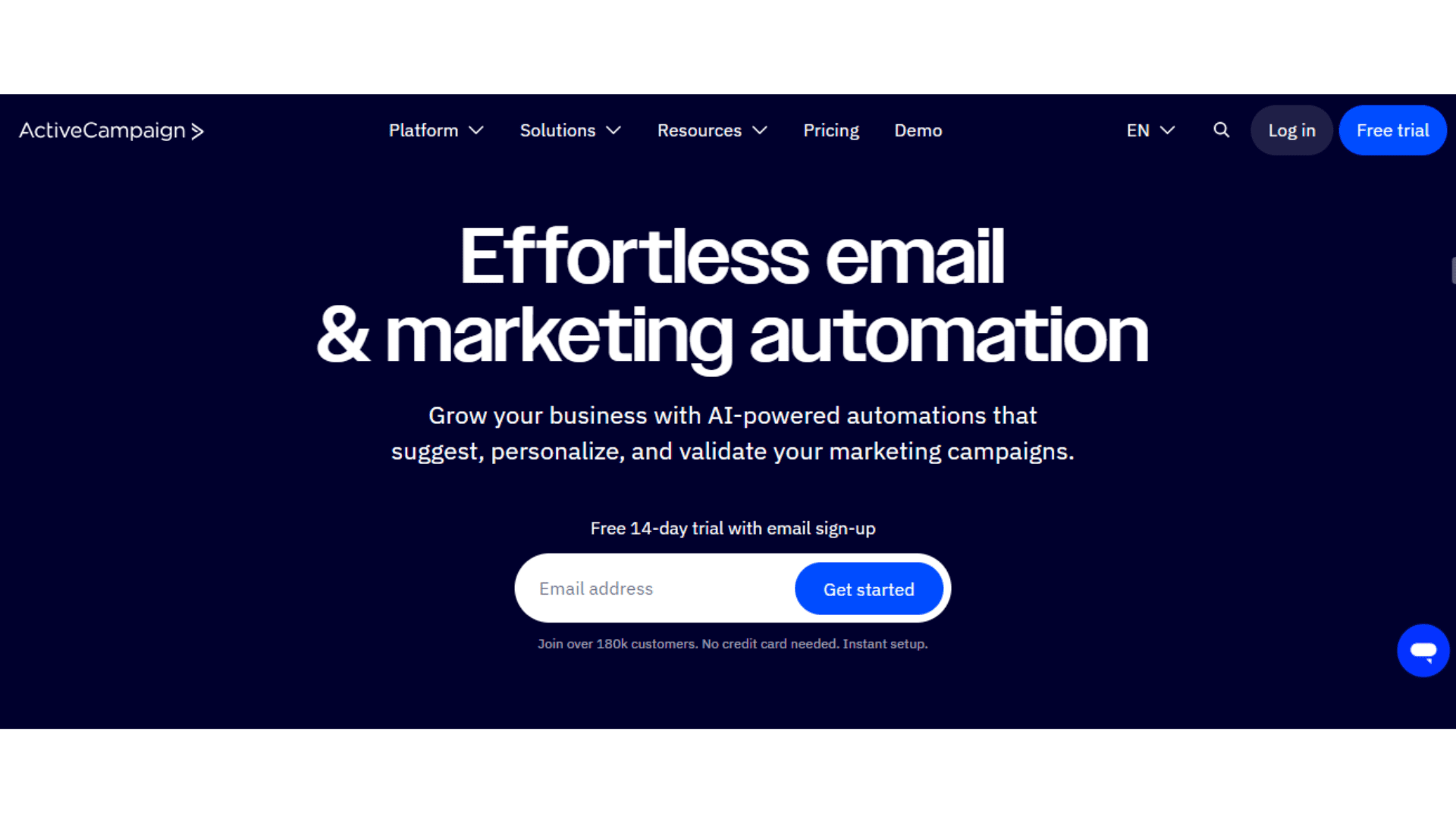
ActiveCampaign is a marketing automation platform designed to help businesses connect and engage with their customers. It offers a suite of tools including email marketing, automation workflows, CRM, and messaging. With a focus on automation and personalization, ActiveCampaign enables businesses to deliver targeted messages to their audience.
Key Features:
- Email Marketing: Design and send personalized emails with ease.
- Marketing Automation: Create complex automation workflows to engage customers at every stage.
- CRM & Sales Automation: Manage contacts, track deals, and automate sales processes.
- Messaging: Connect with customers through SMS and site messages.
- Integrations: Connect with over 900 apps including Shopify, WordPress, and Salesforce.
Who Should Use ActiveCampaign?
ActiveCampaign is ideal for:
- Small to medium-sized businesses seeking robust automation tools.
- Marketers focusing on personalized customer journeys.
- Businesses looking for an affordable yet powerful marketing solution.
What Is HubSpot?
HubSpot is an all-in-one CRM platform that offers tools for marketing, sales, customer service, and content management. It provides businesses with the resources to attract, engage, and delight customers throughout their journey. HubSpot’s modular approach allows businesses to scale their operations effectively.
Key Features:
- CRM: A free CRM to manage contacts, companies, and deals.
- Marketing Hub: Tools for email marketing, social media, SEO, and lead generation.
- Sales Hub: Features like email tracking, meeting scheduling, and pipeline management.
- Service Hub: Customer service tools including ticketing, live chat, and knowledge base.
- CMS Hub: Website content management with SEO recommendations and themes.
Who Should Use HubSpot?
HubSpot is best suited for:
- Businesses looking for a comprehensive, scalable platform.
- Teams that require seamless integration between marketing, sales, and service.
- Organizations aiming to centralize their customer data and interactions.
ActiveCampaign vs. HubSpot – Key Similarities and Differences
Similarities:
- Both offer robust email marketing and automation capabilities.
- Each platform includes CRM functionalities to manage contacts and sales pipelines.
- They provide integrations with popular third-party applications.
- Both platforms offer resources and support to help users get started.
Differences:
| Feature | ActiveCampaign | HubSpot |
| Ease of Use | User-friendly with a focus on automation | Intuitive interface with a comprehensive toolset |
| Onboarding | Free onboarding support | Paid onboarding packages, depending on plan |
| Sales Funnels | Advanced automation workflows | Integrated sales and marketing funnels |
| Marketing Automation | Multi-channel automation including SMS | Comprehensive automation with AI capabilities |
| CRM & Lead Management | Built-in CRM with lead scoring | Robust CRM with customizable properties |
| Membership & Courses | Requires third-party integrations | Requires third-party integrations |
| Webinars | Not natively supported | Not natively supported |
| Landing Pages | Drag-and-drop builder with templates | Advanced landing page builder with A/B testing |
| Integrations | 900+ integrations including Shopify, WordPress | Extensive integrations with major platforms |
| Customer Support | Email and chat support | 24/7 support with dedicated account managers (higher tiers) |
Pricing and Plans
When evaluating marketing platforms, understanding their pricing structures is essential to determine which offers the best value for your business. Let’s explore the pricing plans of ActiveCampaign and HubSpot in detail.
ActiveCampaign Pricing
ActiveCampaign offers a range of pricing plans to accommodate businesses at different stages:
Lite Plan ($15/month): This plan includes email marketing, marketing automation, basic forms, and up to 5 actions per automation. It’s suitable for small businesses starting with email campaigns.
Plus Plan ($49/month): Offers CRM with sales automation, landing pages, Facebook Custom Audiences, SMS marketing, and advanced integrations. Ideal for growing businesses needing more automation features.
Professional Plan ($79/month): Provides predictive sending, split automation, site messages, conversion attribution, and advanced reporting. Designed for businesses requiring deeper analytics and optimized workflows.
Enterprise Plan ($145/month): Grants access to custom reporting, custom domain, dedicated account rep, HIPAA compliance support, and unlimited users. Best for large businesses needing enterprise-level features.
ActiveCampaign also offers a 14-day free trial to explore its features before committing.
HubSpot Pricing
HubSpot takes a modular pricing approach, separating its tools into Hubs. The Marketing Hub is the most comparable to ActiveCampaign. Pricing below is based on annual billing:
Free Plan ($0/month): Includes CRM, email marketing, forms, landing pages, live chat, and basic reporting. A great starting point for businesses wanting to try HubSpot’s ecosystem.
Starter Plan ($20/month): Adds email health insights, removes HubSpot branding, and allows for simple automation and ad retargeting. Best for businesses seeking more flexibility.
Professional Plan ($890/month): Introduces advanced automation, campaign management, A/B testing, SEO recommendations, smart content, custom reporting, and team collaboration features. Suitable for businesses ready to scale their marketing.
Enterprise Plan ($3,600/month): Offers custom objects, predictive lead scoring, advanced permissions, and enterprise-grade security features. Ideal for large-scale operations needing a robust marketing and CRM solution.
HubSpot also provides discounts for startups and annual commitments, though the total cost can grow quickly with add-ons and extra seats.
Comparison Table: Pricing
| Feature | ActiveCampaign | HubSpot |
| Free Plan | 14-day free trial only | Yes, includes basic CRM and marketing tools ✅ |
| Entry-Level Paid Plan | $15/month for up to 500 contacts ✅ | $20/month per seat, billed annually ❌ |
| Mid-Tier Plan | $49/month with CRM and advanced features ✅ | $890/month for advanced automation and analytics ❌ |
| Top-Tier Plan | $145/month with enterprise tools ✅ | $3,600/month with custom objects and enterprise tools ❌ |
| Marketing Automation | Available in all paid plans ✅ | Only available in paid plans ✅ |
| Additional Users | Unlimited users in most plans ✅ | Billed per seat ❌ |
| Cost Scaling | Scales affordably with contact growth ✅ | Can become expensive as contacts and seats increase ❌ |
🌟 Winner:
ActiveCampaign is the better choice for cost-effective marketing automation. It offers powerful features like automation and CRM at a much lower price point. HubSpot’s free plan is attractive for beginners, but its advanced functionality requires a steep investment, making ActiveCampaign a better fit for most growing businesses.
User Experience & Ease of Use
Your marketing platform should be easy to navigate, whether you’re a beginner or an experienced marketer.
ActiveCampaign
ActiveCampaign has a clean and modern interface but includes a wide range of features, which can feel overwhelming at first. Fortunately, it offers step-by-step tutorials, live chat assistance, and onboarding sessions to help users get up to speed. Once you’re familiar with the layout, navigating between email campaigns, automations, and contacts becomes intuitive.
HubSpot
HubSpot stands out for its user experience. The platform is sleek, visually guided, and highly user-friendly—even for complete beginners. With drag-and-drop builders, smart navigation, and contextual help popups, HubSpot delivers one of the smoothest onboarding processes in the industry.
Comparison Table: User Experience
| Feature | ActiveCampaign | HubSpot |
| Ease of Use | Feature-rich, slight learning curve ❌ | Extremely beginner-friendly ✅ |
| Dashboard Design | Clean and functional ✅ | Sleek and highly intuitive ✅ |
| Learning Curve | Moderate learning curve ❌ | Very low learning curve ✅ |
| Onboarding Support | Tutorials, onboarding calls ✅ | Excellent onboarding with in-app guidance ✅ |
🌟 Winner:
HubSpot takes the lead here for its extremely user-friendly interface and gentle learning curve. If ease of use is a top priority, HubSpot is an excellent choice.
Email Marketing Features
Both platforms offer robust email marketing tools, but they differ in depth and flexibility.
ActiveCampaign
ActiveCampaign is known for its powerful email marketing capabilities. It supports advanced segmentation, conditional content, A/B testing, dynamic email content, and predictive sending. Users can create personalized, high-converting email campaigns with ease.
HubSpot
HubSpot’s email tools are easy to use and integrate well with its CRM. While it offers personalization, smart content, and A/B testing in higher-tier plans, many advanced features are locked behind the Professional plan. The visual editor is sleek but more simplified compared to ActiveCampaign.
Comparison Table: Email Marketing
| Feature | ActiveCampaign | HubSpot |
| Email Builder | Drag-and-drop, flexible design ✅ | Drag-and-drop, intuitive ✅ |
| Personalization | Advanced, includes conditional content ✅ | Smart content available in higher plans ✅ |
| Segmentation | Advanced and granular ✅ | Basic on lower plans, advanced on higher plans ❌ |
| A/B Testing | Available in all paid plans ✅ | Available only in Professional and up ❌ |
| Predictive Sending | Available in Pro+ plans ✅ | Not available ❌ |
🌟 Winner:
ActiveCampaign wins this round for its powerful and accessible email marketing tools that are available even in lower-tier plans.
Marketing Automation
Automation is at the heart of both platforms, but their approaches and capabilities vary.
ActiveCampaign
Marketing automation is where ActiveCampaign truly shines. You can build complex, multi-step workflows using a visual automation builder. It supports triggers based on behavior, time, tags, email engagement, site activity, and even SMS. Automation templates also help new users get started.
HubSpot
HubSpot offers marketing automation, but only in its Professional plan and above. Its visual workflow builder is beautiful and intuitive, supporting conditional logic, smart branching, and integration with other Hubs. However, entry-level users won’t have access to these powerful automation tools.
Comparison Table: Marketing Automation
| Feature | ActiveCampaign | HubSpot |
| Visual Workflow Builder | Yes, available in all paid plans ✅ | Yes, available in Professional and up ❌ |
| Behavioral Triggers | Yes ✅ | Yes ✅ |
| Automation Templates | Yes ✅ | Yes ✅ |
| Conditional Logic | Advanced branching and logic ✅ | Available only on higher-tier plans ❌ |
| SMS Automation | Included in Plus and above ✅ | Not natively available ❌ |
🌟 Winner:
ActiveCampaign takes the lead for offering more robust and accessible automation features across all its pricing tiers.
CRM & Contact Management
A good CRM system helps you organize, score, and manage leads effectively.
ActiveCampaign
ActiveCampaign includes a built-in CRM with sales automation tools starting from the Plus plan. It offers deal pipelines, lead scoring, task management, and contact history, allowing users to run sales and marketing campaigns under one roof.
HubSpot
HubSpot’s free CRM is one of its strongest assets. It includes contact and company tracking, deal pipelines, activity logging, and email tracking. The CRM is easy to use and deeply integrated across all Hubs. Paid plans unlock more advanced features like predictive lead scoring and custom reporting.
Comparison Table: CRM & Contact Management
| Feature | ActiveCampaign | HubSpot |
| CRM Availability | Built-in, starts from Plus plan ❌ | Free CRM available to all users ✅ |
| Deal Pipelines | Yes ✅ | Yes ✅ |
| Lead Scoring | Available in Plus and up ✅ | Available in Pro and up ❌ |
| Contact Tracking | Email, behavior, and engagement ✅ | Website activity, emails, forms ✅ |
| Ease of Use | Functional but slightly complex ❌ | Intuitive and beginner-friendly ✅ |
🌟 Winner:
HubSpot wins this category thanks to its powerful free CRM and user-friendly interface. It’s perfect for businesses just starting with contact management.
Integrations
Integrations can make or break your marketing stack. Both platforms connect with popular tools, but there are key differences.
ActiveCampaign
ActiveCampaign integrates with over 870 apps, including Shopify, WordPress, Stripe, and Zapier. It also offers deep native integrations with major platforms like Salesforce, Facebook, and Google Ads. Its API allows for custom connections as well.
HubSpot
HubSpot has a massive app marketplace with over 1,500 integrations. From CRM tools to social media and analytics platforms, the variety is impressive. The integrations work seamlessly thanks to HubSpot’s all-in-one ecosystem. However, some integrations may require higher-tier plans.
Comparison Table: Integrations
| Feature | ActiveCampaign | HubSpot |
| Number of Integrations | 870+ ✅ | 1,500+ ✅ |
| Native Integrations | Yes ✅ | Yes ✅ |
| Zapier Support | Yes ✅ | Yes ✅ |
| Ecommerce Integrations | Shopify, WooCommerce, BigCommerce ✅ | Shopify, Stripe, Zapier, WooCommerce ✅ |
| API Access | Available ✅ | Available ✅ |
🌟 Winner:
HubSpot takes the edge with a larger integration marketplace and tighter connection across its platform tools, though both offer strong support in this area.
Pros and Cons of ActiveCampaign
Pros ✅
✅ Powerful Marketing Automation at All Price Levels
ActiveCampaign is widely known for its advanced marketing automation tools—even in its lower-tier plans. Users can build complex workflows using a visual builder and trigger actions based on user behavior, tags, time-based rules, and more. It’s ideal for businesses that want precise control over their customer journeys.
✅ Highly Customizable Email Campaigns
From dynamic content and conditional blocks to predictive sending and split testing, ActiveCampaign offers some of the most flexible email marketing tools in the market. It empowers users to craft hyper-personalized campaigns that drive engagement and conversions.
✅ Built-In CRM with Sales Automation
Unlike many email platforms that only focus on marketing, ActiveCampaign also includes a CRM with sales automation capabilities. You can manage deals, create pipelines, assign tasks, and track interactions—all in one place.
✅ Affordable Entry-Level Pricing
ActiveCampaign’s pricing starts at just $39/month for its Marketing plan, making it one of the more accessible options for small businesses seeking robust automation without breaking the bank.
✅ Extensive Integrations and API Access
With 870+ native integrations and an open API, ActiveCampaign works seamlessly with major tools like Shopify, WordPress, Stripe, Salesforce, and more. It also integrates well with Zapier, making it easy to connect your entire marketing tech stack.
✅ Excellent Deliverability and Email Infrastructure
ActiveCampaign has a strong reputation for email deliverability. The platform invests in infrastructure and practices that ensure your emails land in inboxes—not spam folders.
Cons ❌
❌ Learning Curve for Beginners
Due to its advanced features and automation capabilities, ActiveCampaign can feel overwhelming to new users. The interface isn’t as beginner-friendly as HubSpot, and users may need some time (and tutorials) to get comfortable.
❌ No Free Plan Available
Unlike HubSpot, ActiveCampaign doesn’t offer a free plan. Although the features are powerful, users must commit to a paid plan from day one, which might not suit very small startups or solopreneurs on a tight budget.
❌ CRM Not Available on Entry-Level Plan
While ActiveCampaign does offer CRM features, these are only accessible starting from the Plus plan ($49/month and up). Users on the Lite plan don’t get sales pipeline functionality, which limits its all-in-one appeal for those just starting out.
❌ Interface Can Feel Cluttered
Although powerful, the user interface can feel dense and somewhat clunky—especially when managing multiple automations, contact lists, and campaigns. It takes some getting used to, particularly if you’re switching from a more visual platform like HubSpot.
❌ Limited Reporting on Lower Plans
Advanced analytics, attribution, and custom reports are only available on the Professional and Enterprise tiers. This limits smaller users from gaining deep insights unless they upgrade.
Pros and Cons of HubSpot
Pros ✅
✅ Free CRM and Marketing Tools
HubSpot’s biggest draw is its generous free plan. It includes a fully functional CRM, email marketing, live chat, forms, and limited automation features—perfect for startups and small businesses looking to grow without initial investment.
✅ Extremely User-Friendly Interface
With its clean layout, drag-and-drop tools, and guided workflows, HubSpot is one of the most intuitive platforms on the market. Even complete beginners can build emails, landing pages, and workflows with confidence.
✅ All-in-One Growth Platform
HubSpot offers tools across marketing, sales, customer service, and CMS—all under one roof. Everything integrates smoothly, allowing businesses to scale and manage their entire customer journey without needing third-party apps.
✅ Scalable with Business Growth
As your business grows, you can unlock advanced tools in HubSpot’s paid tiers—like marketing automation, predictive lead scoring, campaign analytics, and custom reporting—making it a scalable long-term solution.
✅ Strong Educational Resources & Community
HubSpot Academy is filled with free, high-quality courses on marketing, sales, and customer service. Combined with a thriving community and responsive support, users are never alone in their journey.
✅ Built-In SEO, Blogging & CMS Tools
Unlike ActiveCampaign, HubSpot includes blogging tools, SEO optimization, and a full CMS—making it ideal for content marketing and inbound growth strategies.
Cons ❌
❌ Steep Pricing on Higher Plans
HubSpot’s pricing climbs quickly. While the free and Starter plans are affordable, the Professional plan (which unlocks full automation) starts at $800/month. This can be a dealbreaker for small businesses needing more than basic features.
❌ Many Advanced Features Locked Behind Paywall
Core features like A/B testing, advanced automation, and campaign analytics are not available in the free or Starter tiers, forcing users to upgrade for essential capabilities.
❌ Marketing Automation Only on Pro+ Plans
Unlike ActiveCampaign, which includes automation in all paid plans, HubSpot only offers full workflow automation starting with its Professional plan—creating a functional gap for Starter users.
❌ Limited Customization in Free & Starter Plans
While the interface is easy to use, customization options (like conditional content or dynamic personalization) are limited unless you’re on a higher-tier plan.
❌ Complex Billing and Add-On Costs
HubSpot’s pricing can get complicated, with separate Hubs (Marketing, Sales, Service) and add-ons that may result in a higher overall investment than initially expected.
Which One Should You Choose?
💡 Go with ActiveCampaign if:
✅ You want powerful marketing automation and segmentation tools at a lower price point.
✅ You’re experienced with email platforms and don’t mind a steeper learning curve in exchange for advanced features.
✅ You need a built-in CRM with sales automation starting from mid-tier plans.
✅ You’re focused on email, SMS, and behavior-based campaigns and want in-depth customization.
✅ You value affordable plans with flexible email marketing and automation across the board.
💡 Go with HubSpot if:
✅ You’re a beginner or small business looking for a user-friendly CRM and email platform with a generous free plan.
✅ You want to manage marketing, sales, and service from one unified platform.
✅ You’re focused on content marketing, blogging, and SEO alongside email campaigns.
✅ You’re planning to scale and can afford premium tiers as your needs grow.
✅ You appreciate strong educational resources and hands-on customer support to guide your growth.
Final Thoughts
Both ActiveCampaign and HubSpot are powerful tools, but they serve different audiences. ActiveCampaign is best for businesses that need deep automation, advanced segmentation, and flexible campaign control—at a reasonable price. HubSpot, on the other hand, is perfect for beginners and growing businesses looking for an all-in-one platform with a smooth user experience and an excellent free plan.
So, which one is right for you?
✅ If automation power and flexibility are key, go with ActiveCampaign.
✅ If ease of use, free tools, and all-in-one simplicity matter most, HubSpot is your best bet.
Still unsure? Try both platforms (HubSpot has a free plan and ActiveCampaign offers a free trial) and see which one aligns best with your goals. 🚀
FAQ: ActiveCampaign vs HubSpot
1. Which platform is better for beginners—ActiveCampaign or HubSpot?
HubSpot is better for beginners thanks to its clean interface, drag-and-drop tools, and generous free plan that includes CRM and email marketing.
2. Does ActiveCampaign offer a free plan like HubSpot?
No, ActiveCampaign does not offer a free plan. All users must start with a paid subscription, though they do offer a 14-day free trial.
3. Can I use both platforms as a CRM?
Yes, both platforms include CRM features, but HubSpot’s CRM is more user-friendly and available on the free plan, while ActiveCampaign’s CRM is more advanced but only available on higher tiers.
4. Which tool is better for email marketing automation?
ActiveCampaign is the winner when it comes to automation. It offers powerful workflows, triggers, and segmentation—even on lower-tier plans.
5. Is HubSpot worth the higher cost?
Yes, if you’re scaling quickly or want an all-in-one system with CMS, blogging, SEO, and marketing tools. But for smaller teams, the cost can escalate quickly with upgrades and add-ons.

Srishti Gaur is an accomplished SEO Associate with a strong background in content creation and software technology. With a knack for crafting strategies that drive traffic and improve search rankings, she combines her expertise in SEO with a deep understanding of tech tools and platforms. Passionate about bridging the gap between technology and impactful content, Srishti helps businesses grow their online presence and achieve measurable results.