

Choosing the right platform to sell your products online can feel overwhelming—especially when both SamCart and Kartra promise to streamline your sales process. But here’s the thing: nearly 70% of online shoppers abandon their carts before completing a purchase.
That means having a high-converting checkout system or an all-in-one marketing platform can make a huge difference in your revenue. But which one is right for you?
If you’re looking for a checkout-first solution with powerful upsells, SamCart might be the perfect fit. If you need a full-fledged business suite with email marketing, sales funnels, and membership hosting, Kartra could be your best bet.
In this comparison, I’ll break down the key features, pros and cons, and pricing of SamCart vs. Kartra, so you can make the best decision for your business. Let’s dive in! 🚀
| Disclaimer: This article is for informational purposes only. Verify features and pricing on the official SamCart and Kartra websites as they may change over time. |
Table of Contents
SamCart vs. Kartra: Quick Comparison
| Feature | SamCart | Kartra |
| Ease of Use | User-friendly interface; focuses on checkout and sales pages. | Comprehensive platform; may have a steeper learning curve due to extensive features. |
| Sales Funnels | Primarily offers checkout pages with upsell and downsell options. | Advanced funnel-building tools with multi-step sales processes. |
| Marketing Automation | Limited to cart abandonment and basic email integrations. | Robust automation including email, SMS, and behavioral triggers. |
| CRM & Lead Management | Basic customer management; relies on integrations for advanced CRM. | Integrated CRM with detailed lead tracking and segmentation. |
| Membership & Courses | Offers course creation through the Courses App. | Fully integrated membership and course hosting capabilities. |
| Webinars | No native webinar hosting; requires third-party integrations. | Built-in webinar hosting and management. |
| Landing Pages | Provides customizable sales and checkout page templates. | Drag-and-drop page builder with a wide range of templates. |
| Integrations | Integrates with various third-party tools for extended functionality. | Offers native integrations and an API for custom connections. |
| Customer Support | Email support; live chat available on higher-tier plans. | 24/7 chat and email support; extensive knowledge base. |
| Pricing | Starts at $79/month. | Starts at $119/month. |
| Free Trial | 7-day free trial available. | 14-day trial for $1. |
| Best For | Entrepreneurs focusing on straightforward product sales. | Businesses seeking an all-in-one marketing solution. |
What is SamCart?
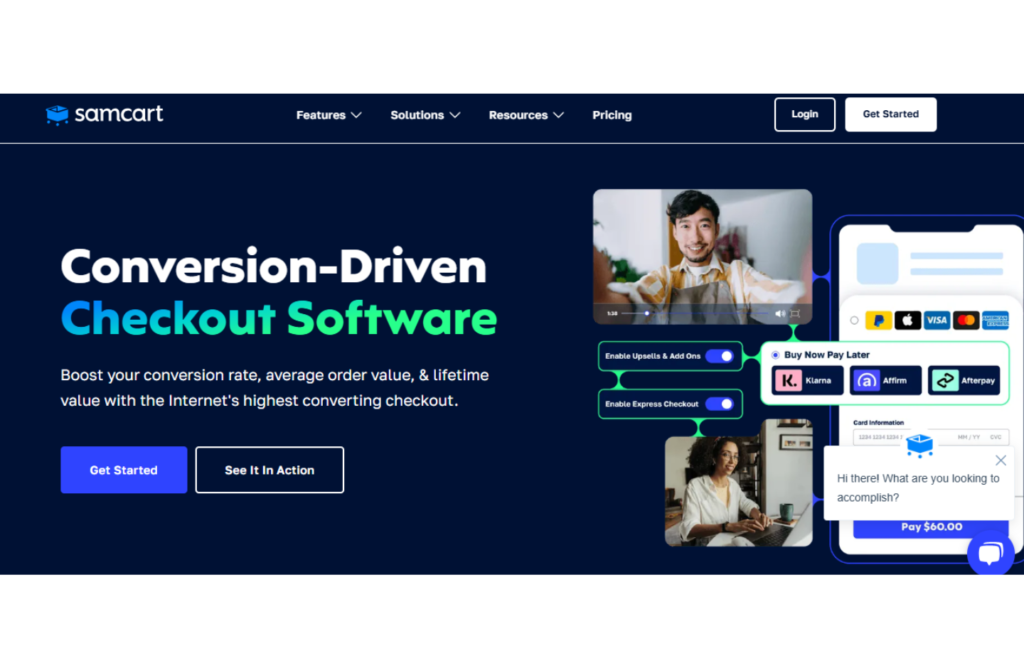
SamCart is a web-based checkout platform designed to optimize the sales process for online businesses. Launched in 2014, it focuses on providing high-converting checkout pages, upsells, and order bumps to increase revenue. SamCart is ideal for entrepreneurs, course creators, and small businesses looking to streamline their sales process without the need for a comprehensive marketing suite.
Who Should Use SamCart?
SamCart is suitable for:
- Entrepreneurs looking for a straightforward platform to manage sales transactions.
- Digital product sellers (e.g., eBooks, online courses).
- Physical product retailers seeking optimized checkout experiences.
- Service providers offering consultations or coaching sessions.
What is Kartra?
Kartra is an all-in-one marketing platform launched in 2018, designed to manage various aspects of an online business. It offers tools for email marketing, sales funnels, membership sites, video hosting, and more, providing a comprehensive solution for businesses aiming to consolidate their marketing and sales processes into a single platform.
Who Should Use Kartra?
Kartra is ideal for:
- Entrepreneurs looking to automate and streamline their marketing efforts.
- Businesses seeking an integrated marketing and sales platform.
- Course creators and coaches managing memberships and online content.
- Agencies handling multiple clients and marketing campaigns.
SamCart vs. Kartra – Key Similarities and Differences
After using both SamCart and Kartra, I’ve noticed key areas where they overlap and where they take different approaches. Let’s break it down!
Similarities
Both SamCart and Kartra are designed to help businesses sell products and services online, but they cater to different needs. However, they share several core features that make them powerful sales platforms.
They both provide:
✅ High-converting sales pages to optimize checkout experiences
✅ Upsell and order bump features to increase average order value
✅ Subscription and payment plan support for recurring revenue models
✅ Affiliate management tools to leverage third-party sales efforts
If you’re an entrepreneur looking to improve your online sales funnel, both platforms offer essential tools to streamline your checkout process and maximize conversions.
And if you want to test the software before committing, both offer free trials:
SamCart: 7-day free trial
Kartra: 14-day trial for $1
Differences
While both platforms focus on selling products, they cater to different types of businesses and have unique strengths.
| Feature | SamCart | Kartra |
| Ideal For | Entrepreneurs, digital product sellers, and course creators | Businesses needing an all-in-one marketing solution |
| Sales Funnel Builder | ❌ No full funnel builder; checkout-focused | ✅ Advanced funnel-building tools with automation |
| Email Marketing | ❌ Requires third-party email integrations | ✅ Built-in email marketing and automation |
| Membership & Courses | ✅ Offers course creation via Courses App | ✅ Fully integrated membership and course hosting |
| Webinars | ❌ No built-in webinar support | ✅ Native webinar hosting and video features |
| CRM & Lead Management | ❌ Basic customer tracking, needs external CRM integration | ✅ Includes built-in CRM with segmentation tools |
| Automation | ❌ Limited to cart abandonment reminders | ✅ Advanced automation including email, SMS, and behavior tracking |
| Pricing | Starts at $79/month | Starts at $119/month |
Checkout Features: SamCart vs. Kartra
A smooth and optimized checkout process is crucial for increasing conversions and minimizing cart abandonment. Both SamCart and Kartra offer robust checkout features, but they cater to different business needs.
SamCart
SamCart is built specifically for checkout and payment processing, making it one of the best platforms for creating high-converting checkout pages. It provides a variety of checkout templates optimized for conversions and features like one-click upsells, order bumps, and A/B testing to maximize revenue.
One of SamCart’s standout features is its cart abandonment recovery tool, which helps businesses recapture lost sales by automatically sending follow-up emails to customers who didn’t complete their purchases.
SamCart also integrates with multiple payment gateways (such as Stripe and PayPal), allowing businesses to offer flexible payment plans and subscriptions.
Kartra
Kartra offers checkout functionality as part of its all-in-one platform, meaning it is not solely focused on checkout like SamCart but still provides a range of features to handle payments. Kartra’s checkout pages are customizable and include built-in upsells, downsells, and order bumps to increase transaction value.
Unlike SamCart, Kartra also includes customer management tools, enabling businesses to track customer activity, automate follow-ups, and segment buyers based on their behavior.
One key advantage of Kartra’s checkout system is its native integration with its CRM, sales funnels, and automation tools, making it easier to create an end-to-end marketing and sales workflow.
Comparison Table: Checkout Features
| Feature | SamCart | Kartra |
| Checkout Page Design | Optimized checkout templates | Customizable checkout pages |
| One-Click Upsells & Downsells | ✅ Yes | ✅ Yes |
| Order Bumps | ✅ Yes | ✅ Yes |
| A/B Testing for Checkouts | ✅ Yes | ❌ No |
| Cart Abandonment Recovery | ✅ Yes | ✅ Yes |
| Subscription & Payment Plans | ✅ Yes | ✅ Yes |
| Built-In CRM & Lead Tracking | ❌ No (Requires integration) | ✅ Yes |
| Integrations with Payment Processors | Stripe, PayPal, and more | Stripe, PayPal, and more |
🏆 Winner: SamCart
SamCart is the better choice if you need a high-converting checkout system with advanced A/B testing, optimized templates, and cart recovery tools. However, if you want checkout functionality integrated with CRM, automation, and marketing features, Kartra is a more comprehensive solution.
Pricing: SamCart vs. Kartra
Understanding the pricing structures of SamCart and Kartra is crucial for selecting the platform that aligns with your budget and business needs. Both platforms offer tiered plans with varying features to accommodate different stages of business growth.
SamCart
SamCart provides three main pricing plans, each designed to cater to businesses at different levels:
- Launch Plan: Priced at $79 per month, this entry-level plan includes:
- Customizable checkout experiences
- One-click checkout with digital wallet support
- Unlimited courses and students
- No-code sales pages with pre-built templates
- Support for one admin user
- Grow Plan: At $159 per month, this plan offers all Launch features plus:
- Advanced checkout automations
- One-click upsells
- Add-ons and order bumps
- Subscription management
- Cart abandonment recovery
- Access for up to three admin users
- Scale Plan: For $319 per month, this comprehensive plan includes all Grow features, along with:
- A/B testing capabilities
- Access to SamCart’s API for custom integrations
- Subscription saver (dunning) features
- Built-in affiliate center
- Advanced CRM integrations
SamCart also offers a 7-day free trial for users to explore the platform before committing.
Kartra
Kartra’s pricing is structured to support businesses as they scale, with several plans available:
- Starter Plan: At $119 per month, this plan includes:
- Management of up to 2,500 contacts
- Unlimited emails and SMS
- One custom domain
- Access to core features like landing pages, email marketing, and sales funnels
- Growth Plan: Priced at $229 per month, this plan offers:
- Support for up to 12,500 contacts
- Unlimited emails and SMS
- Three custom domains
- Advanced automations and affiliate management
- Professional Plan: For $549 per month, this plan includes:
- Management of up to 25,000 contacts
- Unlimited emails and SMS
- Five custom domains
- Real-time funnel analytics
- Webinar hosting for up to 1,000 attendees
- Helpdesk live chat support
Kartra provides a 14-day trial for $1, allowing users to test the platform’s capabilities.
Comparison Table: Pricing
| Feature | SamCart | Kartra |
| Entry-Level Plan | Launch Plan: $79/month (or $59/month billed annually) | Starter Plan: $119/month (or $99/month billed annually) |
| Mid-Tier Plan | Grow Plan: $159/month (or $99/month billed annually) | Growth Plan: $229/month (or $189/month billed annually) |
| Top-Tier Plan | Scale Plan: $319/month (or $199/month billed annually) | Professional Plan: $549/month (or $429/month billed annually) |
| Free Trial | 7-day free trial | 14-day trial for $1 |
| Annual Billing Discount | Yes | Yes |
🏆 Winner: It Depends on Your Needs
If you’re seeking a platform focused on high-converting checkout experiences with features like A/B testing and advanced cart recovery, SamCart offers competitive pricing tailored to these needs. On the other hand, if you require a comprehensive all-in-one marketing solution with integrated email marketing, CRM, and webinar hosting, Kartra provides robust features at a higher price point. Your choice should align with your specific business requirements and budget considerations.
Page Builders: SamCart vs. Kartra
An intuitive page builder is essential for creating engaging and high-converting sales pages without the need for coding expertise. Both SamCart and Kartra offer robust page-building capabilities, but they differ in scope and flexibility.
SamCart
SamCart provides a user-friendly drag-and-drop page builder focused primarily on creating optimized checkout pages and sales funnels. It offers a selection of pre-designed templates that are conversion-focused, allowing users to customize elements such as text, images, and colors to match their branding. While the customization options are straightforward, they are somewhat limited compared to more comprehensive platforms. SamCart’s builder is ideal for users who need to quickly set up streamlined sales pages without extensive design modifications.
Kartra
Kartra features a comprehensive drag-and-drop page builder that enables users to create a wide range of pages, including landing pages, sales pages, and entire websites. It boasts an extensive library of over 500 professionally designed templates, providing flexibility for various business needs. Users can customize every aspect of their pages, from layout structures to individual design elements, ensuring a unique and branded experience. Additionally, Kartra’s builder supports dynamic content, allowing for personalized user experiences based on visitor behavior.
Comparison Table: Page Builders
| Feature | SamCart | Kartra |
| Drag-and-Drop Builder | Yes | Yes |
| Template Library | Limited selection focused on checkout pages | Extensive library with over 500 templates for various page types |
| Customization Options | Basic customization (text, images, colors) | Advanced customization including layout, design elements, and dynamic content |
| Use Case Focus | Optimized for checkout and sales pages | Versatile for landing pages, sales pages, and full websites |
🏆 Winner: Kartra
For businesses seeking a versatile and highly customizable page builder capable of creating a variety of page types, Kartra stands out with its extensive template library and advanced design options. However, for those focused primarily on quickly deploying effective checkout pages, SamCart offers a more streamlined solution.
Course and Membership Features: SamCart vs. Kartra
Offering online courses and membership sites can be a significant revenue stream for many businesses. Both SamCart and Kartra provide tools to facilitate this, but their capabilities differ.
SamCart
SamCart includes a Courses App that allows users to create and deliver unlimited online courses. Features of the Courses App include:
- Drip Content: Schedule content delivery to keep students engaged over time.
- Student Management: Monitor student progress and manage enrollments.
- Task Automation: Automate routine tasks to enhance the learning experience.
- Cross-Selling: Promote additional products or courses to existing students.
While SamCart’s course creation tools are robust, its focus remains on selling products, and the membership features are primarily geared towards course delivery.
Kartra
Kartra offers a comprehensive Memberships feature that enables users to create various types of membership sites, not limited to courses. Key features include:
- Multiple Membership Tiers: Offer different levels of access and content.
- Content Dripping: Schedule content release to maintain member engagement.
- Multi-Portal Access: Manage multiple membership sites from a single dashboard.
- Comprehensive Analytics: Track member activity and engagement levels.
Kartra’s membership capabilities are versatile, supporting a wide range of membership models beyond just online courses.
Comparison Table: Course and Membership Features
| Feature | SamCart | Kartra |
| Course Creation | Yes, via Courses App | Yes, through Memberships feature |
| Membership Site Creation | Limited to course delivery | Supports various membership models |
| Content Dripping | Yes | Yes |
| Multiple Access Levels | No | Yes |
| Analytics | Basic student progress tracking | Advanced member activity analytics |
🏆 Winner: Kartra
For businesses looking to offer a variety of membership types and require advanced management features, Kartra provides a more comprehensive solution. However, for those primarily focused on delivering online courses with integrated sales features, SamCart remains a strong contender.
Page Builders: SamCart vs. Kartra
An intuitive page builder is essential for creating engaging and high-converting sales pages without extensive coding knowledge. Both SamCart and Kartra offer robust page-building tools, but they differ in scope and flexibility.
SamCart
SamCart provides a user-friendly drag-and-drop page builder focused primarily on creating high-converting checkout pages and sales funnels. It offers a selection of pre-designed templates optimized for conversions, allowing users to customize elements such as text, images, and forms to match their branding. While SamCart excels in simplicity and ease of use, its page-building capabilities are more checkout-centric and may lack the extensive design flexibility found in more comprehensive platforms.
Kartra
Kartra features a comprehensive drag-and-drop page builder that enables users to create a wide range of pages, including landing pages, sales pages, and entire websites. With over 500 professionally designed templates, Kartra allows for extensive customization, including adjusting layouts, colors, fonts, and integrating various elements like videos, countdown timers, and forms. All pages are mobile-responsive, ensuring optimal viewing across devices. This flexibility makes Kartra suitable for users seeking to build complex marketing funnels and fully branded web pages.
Comparison Table: Page Builders
| Feature | SamCart | Kartra |
| Drag-and-Drop Editor | Yes | Yes |
| Pre-Designed Templates | Yes | Yes |
| Customization Options | Limited to checkout and sales pages | Extensive, including full websites and various page types |
| Mobile Responsiveness | Yes | Yes |
| Additional Elements | Basic elements like text and images | Advanced elements like videos, countdown timers, forms, and more |
🏆 Winner: Kartra
For users seeking a comprehensive page builder with extensive customization options and a wide variety of templates, Kartra stands out as the superior choice. However, if your primary focus is on creating streamlined checkout pages with ease, SamCart provides a straightforward and effective solution.
Integrations: SamCart vs. Kartra
Integrations with third-party applications enhance a platform’s functionality, allowing businesses to tailor their tech stack to specific needs. SamCart and Kartra offer different approaches to integrations.
SamCart
SamCart supports a variety of integrations with popular email marketing services, payment gateways, and membership platforms. Notable integrations include Mailchimp, AWeber, ConvertKit, Zapier, Stripe, and PayPal. These integrations enable users to connect SamCart with existing tools to manage email campaigns, process payments, and handle memberships. However, users may need to rely on third-party services like Zapier for certain integrations, which could incur additional costs.
Kartra
Kartra is designed as an all-in-one platform, minimizing the need for external integrations by offering built-in solutions for email marketing, CRM, membership sites, and more. For users who require external integrations, Kartra provides connections with Zapier, PayPal, Stripe, and other services. While the platform’s native tools reduce dependency on third-party applications, the range of external integrations is more limited compared to SamCart.
Comparison Table: Integrations
| Feature | SamCart | Kartra |
| Email Marketing | Integrates with services like Mailchimp, AWeber, ConvertKit | Built-in email marketing; integrates with external services via Zapier |
| Payment Gateways | Supports Stripe, PayPal, and Authorize.net | Supports Stripe, PayPal, and Authorize.net |
| Membership Platforms | Integrates with various membership platforms | Built-in membership site functionality; limited external integrations |
| Zapier Integration | Yes | Yes |
| CRM Systems | Requires third-party integrations | Built-in CRM functionality |
🏆 Winner: SamCart
If your business relies on a variety of third-party applications and requires extensive integration capabilities, SamCart offers a broader range of integrations. Conversely, if you prefer an all-in-one solution with native tools that minimize the need for external applications, Kartra may be more suitable.
Support: SamCart vs. Kartra
Reliable customer support is vital for addressing issues promptly and ensuring smooth platform operation. Both SamCart and Kartra offer support options, with differences in accessibility and resources.
SamCart
SamCart provides email support across all plans, with response times varying based on the subscription level. Higher-tier plans offer priority support, including dedicated account managers and personalized onboarding sessions. Additionally, SamCart offers a comprehensive knowledge base, training resources, and access to a community forum for peer assistance.
Kartra
Kartra offers 24/7 support through live chat and a ticketing system, ensuring users can access assistance at any time. The platform also provides an extensive knowledge base, video tutorials, and access to the Kartra Academy for in-depth training. Users can also engage with the Kartra community for additional support and insights.
Comparison Table: Support
| Feature | SamCart | Kartra |
| Support Channels | Email support; priority support on higher plans | 24/7 live chat and ticketing system |
| Onboarding Assistance | Personalized onboarding for higher-tier plans | Kartra Academy with structured training |
| Knowledge Base | Extensive documentation and community forum | Comprehensive knowledge base and community |
| Live Chat Support | ❌ Not available on lower-tier plans | ✅ Available for all users |
| Video Tutorials | ✅ Yes | ✅ Yes |
🏆 Winner: Kartra
Kartra wins this round due to its 24/7 live chat support available for all users, extensive training resources, and structured onboarding through Kartra Academy. While SamCart provides strong support, its lack of live chat for lower-tier users and the need for higher-tier plans to access priority assistance make it less accessible compared to Kartra. If you need instant support and ongoing training, Kartra is the better choice.
Pros and Cons of SamCart
Pros
✅ Optimized Checkout Process
SamCart is specifically designed to maximize conversions with high-converting checkout pages, reducing cart abandonment and increasing sales.
✅ One-Click Upsells & Order Bumps
The platform allows businesses to boost their revenue with one-click upsells, order bumps, and post-purchase offers, making it easy to increase average order value.
✅ Beginner-Friendly & Easy to Use
SamCart has a clean, intuitive interface with a simple drag-and-drop page builder, making it accessible for beginners without a steep learning curve.
✅ Supports Digital & Physical Products
Unlike many competitors, SamCart supports selling both digital and physical products, making it a flexible solution for different types of businesses.
✅ Advanced A/B Testing
SamCart allows users to run split tests on checkout pages, ensuring you can optimize for the best conversion rates.
✅ Subscription & Payment Plan Features
Users can offer recurring subscriptions, payment plans, and installment options, making it ideal for membership-based businesses.
✅ Seamless Integrations with Payment Gateways
SamCart integrates with Stripe, PayPal, Apple Pay, Google Pay, and other major payment processors to provide flexible payment options for customers.
✅ No Additional Transaction Fees
Unlike some competitors, SamCart does not charge extra transaction fees on purchases, keeping more money in your pocket.
Cons
❌ Limited Sales Funnel & Marketing Automation
SamCart does not offer a full funnel-building system, meaning users need third-party integrations for advanced automation and email marketing.
❌ Lack of Built-In CRM
Unlike Kartra, SamCart does not provide customer relationship management (CRM) tools, requiring businesses to integrate with external platforms.
❌ No Membership or Course Hosting
If you’re looking to create a membership site or host courses, SamCart requires third-party tools, as it lacks native membership functionality.
❌ Higher Pricing for Advanced Features
While SamCart’s entry-level plan is affordable, higher-tier plans with features like A/B testing and affiliate management come at a premium price.
Pros and Cons of Kartra
Pros
✅ All-in-One Marketing Platform
Kartra provides everything you need in one place—email marketing, CRM, sales funnels, checkout pages, membership hosting, and automation—reducing the need for multiple software subscriptions.
✅ Advanced Sales Funnel Builder
Unlike SamCart, Kartra offers multi-step sales funnels with automation, tracking, and lead segmentation to maximize conversions.
✅ Built-In Email Marketing & Automation
With Kartra, you don’t need third-party email tools. It includes robust email marketing features like segmentation, automation, and behavioral-based triggers.
✅ Membership & Course Hosting
Kartra allows businesses to create, manage, and sell online courses or membership programs with built-in access control and content dripping.
✅ Affiliate Program Management
Kartra provides a fully integrated affiliate management system, allowing businesses to recruit and manage affiliates without extra tools.
✅ Integrated Help Desk & Customer Support
Unlike SamCart, Kartra includes a built-in help desk with ticketing and live chat support for customers, improving customer service management.
✅ Webinar & Video Hosting Capabilities
Businesses can use Kartra to host live and pre-recorded webinars without third-party webinar platforms, making it great for lead generation and sales presentations.
✅ Customizable Checkout Experience
Kartra offers fully customizable checkout pages with upsells, downsells, and order bumps, allowing businesses to optimize conversions at every step.
Cons
❌ Higher Learning Curve
Because Kartra is an all-in-one solution, new users may find it overwhelming at first, requiring time to fully understand its capabilities.
❌ More Expensive Pricing
Kartra’s starting price is higher than SamCart’s, making it less budget-friendly for small businesses that only need checkout features.
❌ Limited Payment Integrations
Kartra only supports Stripe and PayPal for payment processing, while SamCart offers more flexibility with Apple Pay, Google Pay, and other options.
❌ Not Ideal for Physical Product Sellers
Kartra is best suited for digital products, services, and memberships. Businesses selling physical goods with inventory tracking may find it lacking.
Which One Should You Choose?
💡 Go with SamCart if:
✅ You need a simple, high-converting checkout solution with built-in upsells and order bumps.
✅ You sell digital or physical products and want an easy-to-use platform without complex automation.
✅ You already use external marketing and CRM tools and just need a robust checkout system.
✅ You want A/B testing for checkout pages to optimize conversions.
💡 Go with Kartra if:
✅ You need a full-fledged marketing platform with sales funnels, email automation, and CRM.
✅ You want membership and course hosting built into your platform.
✅ You’re looking for webinar and video hosting as part of your marketing strategy.
✅ You want a fully integrated affiliate program to grow your business through third-party promotions.
Final Thoughts
Now that we’ve broken down the key differences between SamCart and Kartra, which one best fits your business?
- SamCart is perfect for entrepreneurs and small business owners who need an optimized checkout process with high-converting sales pages and payment flexibility.
- Kartra is the go-to choice for businesses looking for an all-in-one marketing solution with built-in automation, sales funnels, and course hosting.
So, which one is best? That depends on your needs!
Both platforms offer free trials, so the best way to decide is to test them out and see which one aligns with your business goals. 🚀
| Pro Tip: Use SamCart if your priority is checkout optimization and boosting conversions. Opt for Kartra if you’re looking for a full-suite marketing solution to scale your business. |
FAQs
1. Which platform is better for sales funnels?
Kartra offers advanced funnel-building tools, while SamCart focuses on checkout optimization.
2. Does SamCart include email marketing?
No, SamCart requires integration with third-party email marketing platforms.
3. Which platform is more affordable?
SamCart is more affordable for businesses focusing solely on checkout systems.
4. Does Kartra handle payment processing?
Yes, Kartra supports payment processing but is not optimized for checkout like SamCart.
5. Who should choose SamCart over Kartra?
Businesses focused on improving checkout conversions and payment management should choose SamCart.

Srishti Gaur is an accomplished SEO Associate with a strong background in content creation and software technology. With a knack for crafting strategies that drive traffic and improve search rankings, she combines her expertise in SEO with a deep understanding of tech tools and platforms. Passionate about bridging the gap between technology and impactful content, Srishti helps businesses grow their online presence and achieve measurable results.